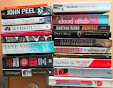
Saturday, 1 September 2012

The Sense of an Ending Julian Barnes


Meeting at: Forester & Flower, August 30th
Well, as a last-minute appearance by Chris W boosted the numbers for the evening from 4 to 5 and Mark Th has already read the book too, we felt the meeting deserved a write up, although Chris B clearly got impatient with me to do this and went ahead and put his notes up here anyway, so my unreliable re-telling of his comments won't be required at least.

Four of us chose the book by mutual consent having agreed that despite there being a small number of us available to meet in August we would meet up anyway. Sense of an Ending is a relatively short book at under 200 pages, but was nevertheless winner of the 2011 Man Booker prize, something a couple of people found surprising. Despite this most of us there seemed to have enjoyed it to a greater or lesser degree.

I found the easy style of the book engaging and it was a nice fluid read, although I hadn't found the back cover synopsis that appealing.  I found it to be an excellent example of storytelling even if, similar to Chris B, I did find the plot structure lacked some credibility at times and it seemed to me that certain elements were mere plot devices which were somewhat contrived, but were nevertheless extremely well used once established.  So I agreed with Chris B that the reasons for Adrian's suicide were questionable and for Veronica's obtusity, but I put them down to being essential for the plot to work.  I found some of the scenarios entertaining and so convincingly described that they became very vivid in my minds eye, and despite being somewhat the anti-hero, I found myself empathising with our protagonist.

Mark T loved the book and also liked the central character a good deal.  The book raised lots of questions for him, none more so than what relationship Adrian or Tony had with Veronica's mother. Overall he found it clever and enjoyable.

Richard found the book to be one of two halves to borrow a footballing pharse. He really enjoyed the first half with such a detailed account of someone's life but was then frustrated that given how well that had been done we were denied any detailed explanation of what had happened in the intervening 30-odd years.  It had echoes for Richard of Chesil Beach and even the Magus (which Mark T also related to) and he was impressed by Barnes' understanding of the way memory works and how memories change over time with sometimes startling impact.(Could this be a theme we come back to as memory plays such a key part in our next two books as well?).

Chris W had not long started reading the book and had some way to go, but was not put off by the fact that we had in effect told him the key elements of what was going to happen later on.  He found Barnes' style to be very perceptive of people and very evocative of the era described in the first part and which he was nearly old enough to remember himself.  He described the prose as "meaty" and often found himself re-reading passages because he took pleasure from how they had been written.

Chris B has added his own comments:

What a suitable book for me and perhaps all of us. The thoughts and adventures of a man in his early sixties  He looks back on his life as a schoolboy, student, worker, lover, husband, father, divorcee and pensioner.  And his student relationships come back to haunt him.

I liked the chatty style and the wry observations on life and relationships, on growing up and on coming to the other end of one's life. The detective story element is intriguing and Tony's differing interpretation of events as he discovers more about the past is very true to life. It is clever to make interesting a character who by his own admission is not the most exciting in the world. Things I didn't like were not being clear by the end on why Adrian (senior) had committed suicide: because he came to a logical conclusion that life wasn't worth living (not just for him but for anyone) or because he had made his girlfriend's mother pregnant? Or Tony's horrible letter? Or all three? Why should it have been so terrible for the latter to have happened? And why is Veronica so obtuse? We know she can behave unexpectedly and is a woman of more mystery than clarity, but why would she not have explained some of the history to Tony, even if she had done so with anger and grief? It makes an interesting personal detective story but seems a bit far fetched. Also, if the main character is 60, I find it odd he is already planning for his own death. But maybe that is just me denying the advance of age.

Though I really liked the reflections on life at and from the perspective of 60, in the end, I found this rather a slight book. So I am not sure why it won the prize. I give it a score of 6.2. 

We know that Mark TH has read the book so we would welcome his comments on it and indeed if others want to read this it is only a short affair so if time allows we can then give it a score reflective of the whole group.

The evening continued with a discussion that ranged from how the authorities are able to study patterns of drug use by analysing household waste water for entire geographical areas, or by analysing individual hairs for individual people, to whether or not the group should start meeting earlier to allow more time for such leisurely chat. Indeed other rather controversial suggestions were brought up as to whether or not meetings could not only start earlier in future, but might even include food and eating.  I shall leave the co-ordination of such radical ideas to our esteemed chairman once he returns from his holiday, but first step might be to see if we could bring forward the meeting time to 8pm or earlier? Finally the kitty was emptied on the evening so there is none to carry forward.

Happy Reading!  Neil

Friday, 27 July 2012

The White Woman on The Green Bicycle - July 2012


The Hare and Hounds, Lansdown.  Apologies from both Chris’s and Mark TH.

Mark TH’s email earlier in the day had suggested that possibly we might be dealing with a Marmite book here and he was definitely a hater not a lover, but as it turned out it was more of a peanut butter book where most people quite liked it to some degree or other while one person clearly had a very definite allergy!
Neil set out the stall with the fact that he was pleasantly surprised by the format of the book which he hadn’t expected, but the fact that the first third was the last part of the story chronologically, followed by three sections which take you back over the preceding 40 years worked well for him.  There was plenty going on in that first section with a reasonably shocking conclusion, and then the next sections did a good job of explaining why things in the first section might have happened. He was absorbed by the characters, although it was not necessarily straight forward as to how you felt about them, and he got a real sense of the place and the atmosphere, while always happy to learn a little about an episode in history that he was previously ignorant about.
He was also particularly interested in the fact that much of this was about the feelings of an ex-pat trailing partner, something a friend of his coaches people on and he felt great empathy with Sabine’s feelings of being trapped on the island.
As the floor opened up, a number of these themes were explored further with other parts being chipped in as well. 
A number of people found the ex-pat nature of the book appealing either because they had spent time as ex-pats (Chris W, Ras) or because they knew and had visited people in that situation (Mark T, Chris B, Neil). Mark T also enjoyed the passion in the book, both because the main characters were “always at it” but also because the population of the island were passionate about their freedom and independence.
Rob found it enjoyable, the characters interesting, the story of independence worthwhile, but did feel he wanted to hear more from George’s perspective and also that one or two episodes in the book lacked credibility, such as the mad dash to catch the cruise ship.
Richard was the biggest detractor on the night having had high expectations of the book after a positive review from wife Gill.  As part of book club lore it is well known that Richard must feel able to empathise with characters in order to enjoy reading about them and he found Sabine in particular to be irritating, facile and pathetic. He also wanted to get to know George better. However, he did enjoy many of the descriptive pieces in the book and found the relating of the drinking culture, the first shopping trip, and the threatening looks from locals to be especially well done.  He was also appalled at the level of domestic violence visited upon George by Sabine, although several others felt he probably got no more than he deserved for his poor behavior towards her.
Ras could also relate to the shopping trip episode.  To a lesser extent than Richard he also felt Sabine could have done a better job of trying to adapt (clearly she wouldn’t have made a very good naval wife  - my comment not Ras’s !) and in an unprecedented move he agreed with Rob that the failed attempt to catch the boat off the island rang a bit hollow.  Nevertheless he enjoyed reading about the island and the people and found the story raised feelings of frustration about peoples’ apologetic attitude towards British colonialism when this book illustrated another example of where the independent rule often had the effect of making conditions worse, for a time at least. This instigated a healthy debate on the subject.
Steve was reluctant to say too much on the evening as he still has quite a bit to read, but his sense so far was that the book was looking like an unexpected pleasure with a pleasingly simplistic form, but he did add that he is finding the Creole accent to be a little irritating to read and possibly a bit overdone.  Steve may yet have the final word on whether we are dealing with Marmite or peanut butter here when he offers his final comments.
Via email we received comments from both Chris’s and Mark TH.  The Chris’s have enjoyed the sense of place, relationships between Sabine and maids, insights into ex-pat marital relationships in the 50’s and the transition out of colonialism, but maybe the book was a bit too long and left too many loose ends? Mark Th gave a pithy bit of feedback…he thought it was rubbish, dull and predictable and wishes we had chosen Sense of an Ending which he thought was “awesome”.  Overall to date the average score for the book is 6.28 pending Steve’s score.
Aside from this we drank nice beer outside on the terrace admiring the handsome views on a warm summer’s evening, a rare treat, whilst bemoaning the fact that the re-vamped H&H doesn’t sell crisps, doesn’t have glasses with handles and doesn’t give great service at the bar…but does have quite pretty waitresses apparently!
It was agreed that discussing Mark T’s book will take place in September and that Neil, Richard, Mark T and Chris B will aim to get together as a small group in August and select a separate book to discuss via email. 

Friday, 29 June 2012

Pereira Maintains, By Antonio Tabbuci


The Fox and Badger, Wellow, Thursday 28th June.
Apologies from Chris B and Steve.
There was a reasonable level of appreciation of Tabuchi's novel about the creeping effects of fascism on pre-war Lisbon, with general disappointment that the book didn`t deliver as much as it promised.
Richard described the politics of Portugal and the Salazar government whose dictatorship had only ended in the 1970s. This regime was well known for its ruthless implementation of fascist ruleat home and overseas. The leadership of the Catholic church too was in cahoots with the fascists although local priests often tried to support the Republican cause when possible.
Richard enjoyed the book – he thought that it was well realised – it grabbed him more as it progressed. He thought that it was well written but not one of the greatest books he`d read. The story was about an old journalist hiding from reality. The young revolutionary Rossi brings him back into the real world. A lot of debate about whether Pereira's final act of rebellion followed by his decision to leave his friends and country was a difficult decision or was it in fact an act of liberation for Rossi? The idea of a confederation of souls – each one taking its turn to come to the fore – was appreciated by both Richard and Rob as an explanation for an individual's character and behaviour.
Mark like the imagery, which took him straight to the streets of Lisbon. Enjoyable but too short and it particularly irritated him every time the word “maintains” cropped up! Apparently the original Italian version was called Pereira “declares” and not “maintains”… but with Steve being absent there was no point arguing whether anything had been lost in translation. Mark thought the idea of Pereira talking to his wife's picture was interesting but then not explored deeply enough.
Rob thought this was a strange book – the story progressively drew him in with its subtle but effective style. A predictable, enjoyable easy read.
Ras was not very impressed with this book – found it difficult to read and it ended up being a damp squib.
Neil too was not very impressed with the book. The introduction at the beginning of the book spoilt it (should have been the back of the book so it could be read afterwards). A week after having read the book he had to reread the end of the book to remember the finale (such as it was…)! He also found the character of Pereira implausible. Would somebody who has worked as a journalist all his life really be so naive? He was depicted as a bit of a bumbling old idiot, which was not realistic.
Chris W was looking forward to reading one of Europe's best translated novels of the 20th century (as promised on the cover) but although the atmosphere and imagery of pre-war Lisbon was good, the book never really delivered. The finale was too brief and it was unlikely that as a journalist Pereira could not have foreseen the outcome of his harbouring Rossi in his apartment. Good that it had informed him about this period in Portugal's history.
Chris`s comments were emailed in from afar. He enjoyed reading about the experience of living ordinary lives under a progressively totalitarian regime, and the historical, cultural and political setting was well painted. The violent event at the end comes as a suitable shock to the “ordinary lives” of the characters. The contrast between the young and sexy revolutionaries and the washed up journalist worked well too. Chris liked the book so much he started to re read it – enjoyably.
So a mixed reception for Antonio Tabucchi in the end… – you can`t please everyone all of the time!

Sunday, 17 June 2012

A Handful of Dust – Evelyn Waugh


The Pulteney Arms. May 31, 2012.
First published in 1934 A Handful of Dust deals with issues of class, social change, loyalty and faith, to name but four. Despite this, it's a shortish novel, written in an accessible style and with a deceptive lightness of touch. Today it is cited by some authorities as one of the great English novels of the 20th century. But what did the Bath Blokes make of it?
A mixed response, it's fair to say. The humour that Waugh uses to make his narrative slip down more easily left some cold. Others enjoyed this aspect of his writing (the description of the Master of Hounds standing in a distant field nibbling forlornly on an ginger nut…) finding it understated and more effective for it. Some found the writing style fairly anonymous, not really making a case for remark – again, others thought the writing highly skilled, the words and themes meticulously chosen, and the book an achievement in covering so much ground in relatively few pages.
To what extent was Waugh's subject matter relevant to us today? The degree to which the narrative was steeped in 1930's upper-class terminology made it harder for some to identify with the characters, and the apparent fickleness with which relationships were regarded raised a barrier to empathy. Some of the characters seemed plain unbelievable (Princess Abdul Akhbar, anyone?).
But there was genuine interest in the legal matters surrounding the plot – the impending change in the divorce laws, and the seemingly ridiculous subterfuges that were required beforehand to effect a legal separation.
On one hand, there was a sense of profound change in established ways of life and expectations – houses being split into flats, the future of Hetton in doubt (becoming a school perhaps – Chris W was very informative about the huge numbers of stately homes and estates that had to be sold to cover death duties pretty much until the 1970s), apparent lack of respect for the sanctity of marriage, and even in Brenda's case for her son's life and death.
As for Waugh himself, it was notable that we did spend quite a lot of time relating what we though about the book to what we thought about him – more than we normally would, I think. Perhaps this was partly because he's a well-documented writer, known to be irascible, perhaps pompous, not suffering fools gladly… but also from a middle class background himself and therefore arguably aligned more with Beaver than anyone else in the book. Ras wasn't impressed by Waugh's war record. We wondered, to what extent did the book's use of racially pejorative terms (shocking to us today) suit his literary purpose, or did they simply reflect the times he was writing about, and did he himself find them easy to use?
It's perhaps no surprise that, as the book's nominator, Steve was a fan - a masterclass in effective and elegant writing, though admittedly stretching credibility on occasion for 21st century consumers. Most support came from Neil and Mark Th, sadly neither of whom were there on the night! With all scores now in it averages 6.48, which slots in between Case Histories and Suite Francaise - mid-table anonymity.

Friday, 27 April 2012

Dreams of Rivers and Seas - Tim Parks

The Ram, Widcombe. April 26th.
This story of dysfunctional family relationships set mainly in India produced a 50:50 split of opinion in the group, like no other. Some people liked the constantly changing narrators, some found this odd. Most liked the plot revolving around the young man discovering his parents and his madness on the death of his father. Some found the end unsatisfactory despite it's unexpected twist (not twisted enough for some). Some liked the portrayal of the characters. We really felt got to know them, except perhaps the father. We all liked different characters with votes for Paul, the visiting academic biographer and the mother Helen. Some thought the son John, an accurate portrayal of a son unable to find his own way in life with distant and professionally obsessed parents. Others thought him not only completely pathetic (where did the empathy and care of our professionals go?) but unconvincing too: too stupid for a Ph D (some of us know otherwise) and not recognising his father's worldwide reputation.
There was also a mixed reception to the portrayal of India with some recognising the experience of Indian streets and a foreigner's shock at the intensity of it all, others critical that, for example, a cheap hotel had air conditioning (and why not?).
Many liked the philosophical themes, often based on opposites e.g. loyalty/betrayal that were brought up but felt they were not explored or explained enough. Some liked the style despite some hiccoughs, others found it slow and unengaging.
Did we like the frequent allusions to sexual and sensual attraction (and the occasional encounter)? On balance, yes. This added to the engagement with the book and the observations e.g. awareness of someone's skin tone and heat were appreciated. Some rather liked the sexy actor girlfriend but couldn't believe she'd go for an older man!
Chris B has been reading Tim Parks' autobiographical book, Teach Me to Sit Still. This explores Tim's journey though his prostate related pain (or is it?) via traditional medicine and absolute scepticism for any alternatives though meditation, shiatsu and Buddhist practice. In the book, he reflects that many of his novels are about people who want to be or are set apart from the world, event to be point of Alberta’s death wish. He notes that this reflects his tendency to become withdrawn, lose interest in intimacy and be accused of beings aloof as a result of his pain. He also observes that these stories "didn't quite satisfy," "didn't really say it". And that reflects our experience of his book too!

Thursday, 29 March 2012

An Ordinary Soldier - Doug Beattie

The Crown, Bathford, March 29th 2012. Good ale!

It was clear from the outset that this book would not be one of our literary classics, which was disappointing in that Doug Beattie MC was assisted by his co-writer Philip Gomm, who as a journalist probably has an A level or a Degree in English.  Notwithstanding this we are in a “book club”; not a “literature club”.  If the literary style irritates – tough – it was easy to read and had few if any grammatical errors.

Doug Beattie was clearly a man with a particularly interesting life.  Who else amongst us has shot their best friend; suffered systematic bullying; guarded Rudolf Hess; served with the UN peacekeeping force in the terrible Balkan war; was part of the initial invasion of Iraq, serving under the Col Tim Collins who made the widely broadcast pre-invasion speech to his troops. Doug Beattie’s account was frank and honest. That gave the book considerable credibility, however many of these failings grated with me/us.  As for the assault on Garmsir it was amazing how chaotic it all appeared and how much “lead” flew around without hitting much.  The chaos was not unexpected; there is a saying in military circles that all plans, however well found will not survive first contact with the enemy, due to human error, communications or technical breakdown.  In spite of this they (the British OMLT) seemed quite fearless standing up in their un-armoured Land Rovers to return fire against the Taliban.  Neil needs a big thank you for pointing out the U-Tube link to the documentary about this assault on Garmsir.  It is well worth a visit, giving a different perspective and adding context to the book. 

There were comments below about the unfairness of the war in that air strikes can be brought in “at will” (not so in the book), but this is an asymmetric war where the Taliban attack at their time and place of choosing and lob mortars into areas populated by their own people.  The only moral call here is that probably the Taliban have more right to kill their own people than we do, although we have been invited Afghan Government to be there.  (I don’t intend opening that particular can of worms, it was just a note on the morals of how the war is conducted.  Don’t blame the messenger – tell Mr Blair.)  Each day in Garmsir seemed similar to the previous one.  It probably was and all credit to the ANA, ANP and OMLT for sticking to their task, retaking the town and actually encouraging the locals to return home and open shops etc.  It was not the author’s fault that the mission was inevitably going to fail when the ANP & ANA could not hold the town as the support was withdrawn.  It was a gutsy hard won battle and an inspiring read for it.

The following additional comments were offered:

Steve had not finished the book, being about half way through.  Doug Beattie tries to be introspective, but his experiences were so profound that he could not find the words to tell the story.  The writing style was naïve and cliché overloaded – in particular the description of the suicide bombing in the opening chapter.  It could have been a better book if the co-writer had done his job better.

Mark T was irritated by the style – GCSE essay style, and reading about things he did not agree with, i.e. the wars in Iraq and Afghanistan.  He is only half way through, but encouraged at the meeting to complete the book and provide a score.

Richard felt the book was full of thoughts and feeling, but if there was a ghost writer why was it so bad?  He liked the autobiographical approach and was sorry it was not developed more fully.  He like less the details of each days skirmishes which were samey and in particular his self description as a buffoon and he was convinced this is not true and downplaying himself was grating.

Chris B agreed with the style issues, but thought there were exciting situations described and was impressed by their response to them.  It was easy to read in spite of the style.  It was a classic war book highlighting the chaos, luck/ill luck of war.  The human portrayal was real, but the whole situation was frustrating.

Mark Th thought the writing quality was never an issue - it was uniformly bad throughout.  However, the last 120 pages were compelling for revealing his honesty, frustration and the way he showed that even the most heroic fighters can be prone to self-doubt, guilt and fear. The caricature of the Afghans and in particular General Gulshan also struck a chord of credibility.  The first 2/3 of the book were not so good, partly because he sketched over his past life so superficially, and partly also because the memoir of a soldier who enlists to fight as a career as he did is less interesting for me than a story told by someone who never planned to fight, as was so often the case in the two world wars.  My biggest problem with the book was the sheer boredom of reading the early battle scenes.

Chris W: Although you can't enjoy a book about a war that is being fought as I write I found this months long titled book very gripping and "unputdownable". Beattie describes in clear unpretentious prose the details of the fighting going on apparently on our behalf in Afghanistan. Even he is surprised that he survives the amount of lead sent his way. This phone precludes further text but among the things I will remember are the close relationships that developed when fighting a common enemy not only with his afghan troops and squaddie mates but also the distrust between the army and police who are meant to be on the same side. It doesn't augur well for the future.

Rob: it failed on almost every front. Accepted that the quality of writing was poor from the outset. In particular, he seemed to have no concept of how to introduce people and situations in a way that gave context and 'colour'. Probably the worst example was when his wife suddenly appeared as a completely unexplained character - we were expected to be shocked by him writing how she was neglected (e.g. Him not being present at the birth - surprise, surprise), nearly vomited when reading "she was right, I did have a mistress, the army". Pathetic cliché. Learnt nothing about what is going on in Afghanistan from the book that I hadn't already got from the BBC and the Guardian. Had hoped for something new - but no. Carried on reading it to the end, because genuinely wanted to know what was happening to the author - but that was because he was a real, current day person put there by our Govt., and not because of either the writing style or the depth of content.

Thursday, 1 March 2012

Fingersmith - Sarah Waters

Devonshire Arms, Sarah Waters seemed to get a thumbs from all, while falling short of rave reviews.  There was agreement for example that the first plot twist was both impressive and impossible to second guess.   

Mark Th felt it was a fine read, though not quite as good as Affinity.  Mark T found the plot really exciting and saw Fingersmith as a modern take on gothic authors like Wilkie Collins.  He found the love scenes convincingly erotic and also noted how well Waters had evoked the look and feel of London.  He had looked forward to each reading of the book.  Chris W enjoyed it too, but felt it was some 200 pages to long with too much in the Maud section that was repetition. His suspicion was that Waters wrote in the hope of having a film based on the novel.  He enjoyed the plot twists and the imagery of the flight from Briar and felt that there was real dramatic tension at times.  However, the ending was predictable and the plot at times unconvincing – would Sue really seem convincingly mad, he wondered?  This was echoed by Ras, who also felt that it was, on balance a good book.  For Ras the plot was unnecessarily convoluted – why not just pitch up at Briar with the letter and a good lawyer and get the loot?  He also enjoyed the imagery, atmosphere and the description.  He also questioned whether a nocturnal marriage ceremony was legal at his time.  

 Neil, having read all of SW’s oeuvre, had not re-read it for the meeting, but felt that it is a book that says long in the memory with its vivid description and imagery.  The period feel was a real strength of the book.  Steve had yet to complete, but was enjoying it thus far and contrasted it favourably with Alison Weir as a book written by a real author.  He was full of praise for the language and the rhythms of Water’s prose.  Chris B had also yet to complete, but had already noted that the surroundings and the description of familiar places in a very different time as an impressive feature. Richard had agreed with the view that character and plot were well handled (despite having gone over to the dark side of electronic readership).   

Rob had also liked the book, as well as raising questions about the male characters’ individual and collective weaknesses, and the critique of pornography possibly implied.  Here views were mixed, with some seeing Gentleman as a pivotal character in the book, some seeing the book as pointing up the dangers of pornography, while others saw it as a device that showed the upper middle classes, for all their piety, as no more moral than the residents of Lant Street.