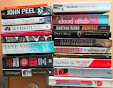
Views were mixed. Some, with dark recollections of Wolf Hall still reverberating from a couple of years ago, had looked on the task of reading this book as a ordeal to be suffered rather than enjoyed, and I'm not sure any who felt like that found their preconceptions totally upended. One sceptic, not completing the book for the meeting, did resolve to persevere (and I, not a doubter, also hadn't finished despite having selected it – took me another week).
There were at least a couple of points of general agreement I think: that this was, on the whole, an easier and more involving book to read than the Wolf Hall. Some felt that her editors/publishers must have taken her to task and insisted that she sort out the style difficulty, widely reported and commented on in Wolf Hall, that meant readers struggled to work out exactly who was speaking and who was being spoken about. In this book it became clear early on that when Mantel spoke of 'he', she almost invariably meant Cromwell. Somehow this never really clicked in the first book. Similarly, she peppered her narrative with phrases like " he, Cromwell, looked over at…' – just to make sure.
So it was easier to consume. It was variously very interesting, or not as interesting as it could have been. 'Not a very interesting part of history', 'been done to death already'… 'You know how it ends'… but for others the 'camera on the shoulder' approach to a historical narrative was spell-binding and lent the period a very fresh perspective.
The book undoubtedly presented a thoroughly absorbing characterisation of Thomas Cromwell who was clearly so hugely influential in the politics of the time – and no-one has done this before. The parallel was drawn, somewhat tongue in cheek, with Tony Soprano – a kind of tragic hero, highly intelligent, totally obsessed with his role, the expansion of his influence and the fortunes of his own (what remained of them) – but also revelling in the ability to make or break others.
I think we all felt that at times there was a bit too much context, detail and innuendo being trowelled on. The line between accurate history and historical novel was constantly blurred, and for some this was an issue – do you believe in it (or doubt it) as an account of what actually happened, or do you suspend your disbelief, let Mantel guide you through her quite fruity interpretation of events and enjoy the journey?
For some this is a tremendous book – painting a vivid and utterly absorbing picture of a part of history of which we have no digital evidence, no photographs, no YouTube footage. She give you the tools to run the movie in your head, in Technicolour. Equally I don't think anyone felt this was a really awful book - or not as bad as perhaps was feared. Some wished Mantel had perhaps taken her historical 'responsibilities' a little more seriously and told us more about the direct influence that Cromwell had on the way the country was governed. Others just wished she'd get on with it and tell the story.
I'm not sure if HM has confirmed that a third part is to be published, though noises of the kind have been heard. Perhaps that is where we'll learn more about the way Cromwell worked when not managing the King's rather sad and desperate obsession with producing a healthy male heir. If it comes, I will read it, but perhaps will stop short of inflicting it on the assembled multitude!
Monday, 21 April 2014

Sunday, 20 April 2014
Archangel by Richard Harris
So, to the book: as you will have seen from emails in from Mark Th, Steve and Richard, Archangel has not set the club alight, but views ranged from it being a pretty good book with a rather less good ending, to it being a dreadful book with and ridiculously bad ending. Of those present the views were roughly as follows:
Mark T had not expected to enjoy the boo at all and found it better than expected, with insights into Russia etc, but felt that a book such as this that is almost entirely plot-driven and lacked any subtleties about what the characters feelings were about events etc was lacking and he could not forgive it for this.
Rob felt similarly and thought that in a similar fashion to Ghost, one of Harris’ other novels that has been turned into a film starring Ewan McGregor, that the author had been so set on pursuing a lot line that he had drafted up in advance that he missed great opportunities to explore other avenues that Rob was sure would have provided more interesting material. Having said the he enjoyed the history lesson about Stalin and was comforted to know that Harris was previously an investigative journalist of some repute and that his research could reasonably be relied on to be fairly accurate.
Chris was a bit more enthusiastic, certainly about the first half to two thirds of the novel but felt that the ending let it down very badly. I was slightly disadvantaged in that I had read the book a number of years ago and actually had a hard cover version of it (sorry, forgot I shouldn’t mention the H word, far too controversial) and so had to rely on distant memories. I am a fan of Robert Harris and have enjoyed reading his books ever since Fatherland, his first, which I thought was a brilliantly conceived storyline. I also remembered enjoying the setting for this book as it was the Moscow I first got to know only a few years before Archangel was written and I revelled in his perspective of the place. Nevertheless, I was also disenchanted with the ending and the plausibility of it which moderated my own scoring.
So, overall not a very well received book, with scores ranging so fa between 2 and 6.5. I am hoping Rob kept a note of them though as I’m afraid I didn’t so I can only reliably confirm that my own score matched Richards at 6.5.
Despite our small numbers it was an enjoyable meeting, especially for me having missed so many over the last 9 months, and the conversation continued and touched on subjects both closely related to the book (why did Stalin get off so lightly in historical reckoning compared to Hitler, and did Blair and Bush commit real crimes against humanity that are only lessened by virtue of scale), the book club (the H-word and electronic readers it seems will always be a topic for conversation) and beyond (retirement for example and what to do with it, especially for those fortunate enough to have index-related, state funded pensions).
Sunday, 25 August 2013
The Unlikely Pilgrimage of Harold Fry, by Rachel Joyce
Discussed Thursday, 22nd
August 2013, Forester & Flower, Combe Down
As
often, there were a range of views – some thought that it was a good and
enjoyable book, others were irritated by the lack of realism.
Selected
by Richard as his wife had recommended it, his summary suggested that as Rachel
Joyce is a writer of successful radio plays, there was quite good dialogue and
story development. Initially, he rather disliked it, feeling that it was unrealistic,
light, and a little meaningless; but by the end, he felt that it was interesting,
quite well written, and written from a ‘magical realism’ perspective which means
that one needed to suspend judgement (shoes which don’t wear out, foraging off
the land with no experience, etc etc).
From
reading other reviews, Richard realised that the book was an updated version of
an old form of writing, the allegory. Once it had been mentioned in a review,
the links with “Pilgrim’s Progress: the journey of Christian through Vanity
Fair and the Slough of Despond to the Celestial City” seemed quite clear: a humble,
everyman hero struggling on his way, with his burden on his back. Obviously some
of the religious symbolism in Pilgrim’s Progress isn’t here in this modern-day
version, but Harold is an Everyman figure whose spiritual journey is prone to
pitfalls and distraction and presented as both heroic and mundane. Some of the
symbolism related to the fact that ostensibly Harold Fry is setting out on his
long walk from Devon to Berwick-on-Tweed to save his friend, Queenie Hennessy,
who is dying of cancer in a nursing home; but this was also a symbolic journey,
with Harold trying to save himself from the "slough of despond" into
which his own life has sunk. One person suggested that the whole book could
almost have been Harold’s fantasy.
Although a wide range of views was expressed, most fell into one of two categories: those who liked and enjoyed it, and those who found it unrealistic, shallow and frustrating.
Although a wide range of views was expressed, most fell into one of two categories: those who liked and enjoyed it, and those who found it unrealistic, shallow and frustrating.
Positives
included:
· the easy style,
· good dialogue,
· Harold and Maureen
- good and quite well drawn characters (although ‘magical realism’ here again –
not really believable, and many realised from the first introduction that David
had died)’
· a book celebrating the kindness of strangers,
· Harold's non-judgmental responses to everyone he meets
forms the crux of the narrative,
· A novel inspired by loss, it contains a really good summation of grief – not expressed by Harold, but by his neighbour Rex (also a figure from Bunyan: named Plausible), who is gradually coming to terms with the death of his wife: "I miss her all the time. I know in my head that she has gone. The only difference is that I am getting used to the pain. It's like discovering a great hole in the ground. To begin with, you forget it's there and keep falling in. After a while, it's still there, but you learn to walk round it.”
· A novel inspired by loss, it contains a really good summation of grief – not expressed by Harold, but by his neighbour Rex (also a figure from Bunyan: named Plausible), who is gradually coming to terms with the death of his wife: "I miss her all the time. I know in my head that she has gone. The only difference is that I am getting used to the pain. It's like discovering a great hole in the ground. To begin with, you forget it's there and keep falling in. After a while, it's still there, but you learn to walk round it.”
Negatives:
·
prone to
sentimentality,
·
the
overpoweringly good intentions of its hero can seem a little pious
·
unrealistic
Overall:
· Richard felt
that it was a good read and enjoyed lots about it.
· Mark T liked it,
feeling that the it was rather Murakami-like and allowed one to suspend realism.
· Chris B “loved
it”, enjoyed the fact that it started in Kingsbridge (a place he knows well
(and one slight irritation is that there is NO petrol station where the book
describes one!), liked the fact that Harold was an ordinary man – and throughout
the book, felt that this was a consistent picture being painted, felt the
relationship between the spouses was a very true reflection, liked how both characters
developed, liked the anti-climax at the end; and loved the idea of just putting
one foot in front of the other. “I thoroughly enjoyed the book.”
· Ras was
frustrated by Harold and his refusal to (for example) wear boots when walking.
He found he had not a lot of sympathy for Harold, although it was good to see
that he did complete the walk and get there. On the other hand, he felt that Maureen
came over quite well; the hangers-on were different and realistic and well done
– overall, a reasonably enjoyable read but frustrated by Harold.
· Chris W felt
that it was shallow and missed the opportunity to create more believable
characters. In some ways, similar to the 100-year-old-man, irritating, very
light-hearted but without the humour of that book. The hangers-on wanting to
link in with his celebrity was more believable.
· Steve said (by e-mail)
that: “I'll send
a review shortly but in brief, I thought this was a very consumable but rather
lightweight book. Designed to appeal to the concerns of middle England (dead
marriages, talking to strangers, being blind to the reality of family
relationships, the meaning of life…) it was filled with recognisable
characters, in settings anyone up and down the country could identify with.
However, for me it also had a constant air of implausibility. How likely would
My Fry really be to keep walking without thinking the better of it - especially
given the kind of man the author had so carefully described? Mrs Fry was a
pantomime villainess for the first part and her reformation as the book went on
also stretched credibility. In the end, I couldn't give a toss whether he
got there or not. Disappointed, because I'd wanted to read it for a while.”
· Neil said (by
email) that “I have to
admit to being a little confused by my feelings towards this book. On the one
hand the simplistic storytelling riddled with such unlikely scenarios felt even
more ridiculous than those described in that rather similar book, 100 year old
man who.. The idea that Harold would just set off on this walk and keep going,
that he would walk for weeks in the same pair of completely inappropriate shoes
and the same clothes, managing to live off the land at times, etc. etc. was
hard to swallow as was the highly contrived bunch of misfits that joined him
and then equally suddenly disappeared with no interest in his journey's end.
But while all this was driving me nuts, the underlying emotional story of
his relationship with his wife and the tragic backstory of their son did hold
my attention and I found myself emotionally quite involved by the end. However,
I am inclined to put that down to my state of mind at the time rather than the
book and looking back, while this was an easy read, I am left with a feeling of
it having been rather unsatisfying. The redeeming feature of 100 year old
man for me was the dry humour that ran throughout, while this book seemed to
wallow in mawkish reflection on scenarios that seem to have been lifted
entirely from 1970's TV plays. When I finished the book I might have been
inclined to give it a 6.5, but with the benefit of hindsight this has slipped
to a 5.”
Thursday, 15 August 2013
The hundred-year man who jumped out of the window and disappeared - by Jonas Jonassen
The hundred-year man who jumped out of the window and disappeared - by Jonas Jonassen
Discussed April 2013


As usual there was quite a variety of opinion on this book bringing out both lighthearted amusement and enjoyment with some and irritation and  tedium with others.

So, what were the good bits?

* Interesting how the book interwove a variety of scenes in 20th century history
* Simplistic light-hearted Swedish humour
* Innocence and quirkiness of the story
* Marginal implausibility of the storyline throughout(just a bit)
* The concept of an OAP breaking loose from the shackles of his Home and finding freedom.
* The use of vodka throughout to lubricate the storyline.
* A reminder of the good old days growing up making pipe bombs !?
* The escapism of climbing through a window to live a hedonistic lifestyle
* The subtle interlinking of Presidents and world leaders into the story
* Lightly written and better than Dickens -Mildly amusing and occasionally enjoyable.

and the less good bits.....

* The Swedish humour does not translate well - too much slapstick and lack of sophistication
* Silly, farcical and repetitive
* Were all the historical flashbacks really correct? Misleading information about nuclear weapons.
* Tiresome and the rot really set in when the elephant turned up!
* Could have been a shorter novella.
* Leading character was too a-political.
* Story lacked any female involvement
* Rather like the Tom Sharpe Wilt farces - basic unsophisticated humour level.

- So really a book you've got to read to find out whether it amuses or irritates you.

Interestingly after the initial debate there was then discussion about whether in fact there were  more profound and hidden meanings in the book than had been discovered. Was it just  a lighthearted and ' frothy' read or was there was much more depth in the story that might have been missed by the erudite panel? Well nobody was quite sure but it was clear that with a lot of vodka the story moved along with a fair pace which kept everybody mildly amused some of the time.
.... Perhaps the final message ( as retirement beckons - for some anyway ) was that there may be hope for all of us .......so long as we can still get our leg over the window cill. ( no jokes)

Chris W.
Richard V: I have finally read this, having now managed to catch up on the books I could not get in India. I really enjoyed this book, for lots of reasons. I enjoyed the easy style and found the humour generally acceptable (unusually for me) and I very much enjoyed the overall quirkiness of it. I really liked the speedy examination of most of the important historical events over the 20th century, and the book reminded me a lot of the Woody Allen film, Zelig, where WA appears as part of all of these historic situations - and that was what our protagonist did here, too.
So, a clever book, rather erudite in its understanding of history (although, having read Chris's notes above, I agree that he may not have represented the creation of the Atomic Bomb with complete accuracy!), and with a very light touch. I might recommend it to someone who dislikes history but would quite like to know what did happen in the world over the last 100 years!
I see the notes above have no scores, but my score is: 7.5
Monday, 22 April 2013
The Inheritors - William Golding
The Pulteney Arms, Bath, March 28th 2013. Present: SC, CW, RA, RG, CB, RV
A respectable six gathered to discuss Golding's
rapidly-written second novel. Selected by Steve because he'd become very
familiar with the spine in his youth, when it occupied one of the shelves in
the upstairs toilet, and had subsequently retained an uneasy feeling of
unfinished business…
Fair to say the club shot off in all directions over this.
Two contrasting but eminently enjoyable reviews are quoted later in their
entirety – because they're worth it – but before those, here are some selected thoughts.
A number of us had difficulty in relating to events and
locations as they were described. Despite the extensive foreword that explained
how Golding went to great lengths to ensure he'd got the topography right (by
asking a fellow teacher), there was a common struggle to visualise the details of the action. To some extent this was because Golding wanted us to understand that the
surroundings meant everything to the protagonists. So events were so bound up
in the setting that it was of critical importance to be able to see it – to
have a picture. Some of us felt Golding fell a bit short in carrying that off.
The book was undoubtedly thought-provoking. One of our longer
discussions ensued, covering Neanderthal/Homo Sapiens overlap, black/white skin
(wouldn't the first Homo Sapiens have been black?). Intelligent use of
different styles to point up the gulf between the two: the compelling innocence
of Lok against the sinister plotting and wider knowledge (and two-syllable name
– Bath Rugby eat your hearts out) of Tuami.
RV made the point that the book contained strong references
to and inferences of lost skills, along with the lost innocence of the
Neanderthals. These included telepathy or certainly to knowing (and trusting)
something without understanding what it was.
Scores ranged between a sandpapered 3 and a sangria-fuelled
9.8. This month's contest to win a slightly-foxed edition of 'Fanny's Fancies'
(1963) is to identify the reviewer responsible for each of those scores. Neil
wrote:
'I have a picture.
There is a large pile of stones like a cave and inside
people are talking and drinking off-honey from clear jars, but I am not there.
I am in a hot place, much sand, I am not by the sea, but it is nearby. I have a
square black stone and it has many words. When I touch it more words come, and
more and more. Words, like twig and log and stag, but they do not mean twig or
log or stag and it hurts my head. Outer Neil wants to be clever and make the
people clap, but inner Neil is sad and heavy because of all the words he cannot
make sense of. The New People like these words and say it is clever, but I am
one of the people from the overhang who does not share this picture and thinks
the words are like when the people go to the river and instead of making water
they make the other thing...these words are the other thing. Maybe if I touch
the stone again tomorrow some new words will be there about old Mal climbing
out of a hole in the stone cave and could not be found and these words will be
simple and make Neil laugh and talk.'
(Neil was stuck in Dubai for work while reading the book).
And this is Mark Th's view:
'Neil’s
excellent spoof of the Inheritors came close to the anxieties I had before
re-reading it. I had read and really enjoyed this book in my early twenties and
was worried that second time around – like Crime and Punishment – it would
seem only half the book I remembered from my relative youth. In particular I
wondered if Golding’s conceit of making the Neanderthals gentle and loving and
showing humans as inherently violent would feel effective on second reading,
and also the Neanderthal mindset might seem unconvincing or silly. In this case
though, the book was just as rewarding second time around. It still seems
extraordinary that a writer would take the risk of writing a novel (mainly)
from the point of view of a Neanderthal and manage to tell a story that grips
as much as this did. Even more bravely he chose the least intelligent of the
group who is innocently unable to comprehend what he is seeing at all and so
cannot ‘get’ the new people that have moved in. I can sympathise with the view
that this means the reader cannot know exactly what is happening and has to
infer what might be going on and that this can be frustrating. But I did not
mind this at all and felt that the last chapter resolved, at least in a general
sense, what had been going on as the humans panicked, fell back on ritualistic
behaviour and demonised the Neanderthals. The penultimate chapter where he pans
back and describes Lok's ending was so powerfully moving that it comes to mind
well after the end of the book. I loved the way he created a sense of the
Neanderthal outlook - locked in the present, tied to the senses and with (like
a young human child) little working memory and limited ability to think
logically. The picture of humans as seeking to survive but also seeking power,
being fearful of outsiders and capable of justifying extreme violence towards
those we have caricatured as evil (Saddam, Jews, Tutsis, Bosnian muslims etc)
was deeply shocking when presented in this simple and stark way (though my
reservation is that the book is perhaps too pessimistic in its take).'
(Mark was
on holiday).
More words
than usual but I honestly can't think of anything to add to those two reviews –
thanks for contributing them!
Monday, 4 March 2013
Half Blood Blues - Esi Edugyan
The Crown, Bathford, 28th February 2013
A select group, with absentees due to overseas engagements, thespian diversions and ill health.
It was a qualified thumbs up for Half Blood Blues. Chris B
(whose choice it was and who sent his notes ahead) spoke for most of us when he highlighted the book's general accessibility –
despite the extensive use of vernacular, it 'winged along' nicely. We bought
into the atmosphere, the way the tension of the immediate pre-war period and
then of the fall of Paris was used not just as a background but as a framework
for the story. The part of the story involving Sid and Chip as older men also
created a believable and affectionate portrait of two old sparring partners,
who had been through a lot together and who still (at least on Sid's part)
hadn't really worked it all out.
Lots to enjoy: The detective story structure kept us
guessing until the end, and then didn't necessarily fill in all the blanks,
depending on your point of view. There was a great love story going on between
Sid and Delilah, which most felt was sensitively and powerfully expressed – we
really felt his frustration and empathized with his lack of faith in his
ability to compete with a younger man, and cheered for him when he got his girl
(for a while, at least). Sid was a very human and fallible narrator/protagonist.
Edugyan's writing style was compact yet powerful; there were
some passages that demanded to be read again simply because you suddenly
realized that she'd painted a tremendously powerful picture without making you
aware of any kind of elaborate setup – guerrilla writing? For example Hiero's
playing was effectively described as 'solar'… This unpretentious voice helped
the narrative to flow, and in particular her gift for striking a believable
note in dialogue between 'blokey blokes' was noted and appreciated. The simple
idea of US and German jazz musicians, black and white, getting together just
for the love of the music, made for a beguiling central thread.
It wasn't a smooth ride all the way however: There was some
trenchant criticism that the book managed, despite its central theme, to avoid
any mention of the Nazi sterilization programme that – some sources say –
rendered all German-born blacks incapable of procreation by 1937. And there was
quite a lot of discussion about the credibility of the plot. Did we really
believe or relate to the motivation that drove Sid to pull the visa trick?
Would Sid's obvious (but usually resigned rather than bitter and twisted)
jealousy have come out that way? For several that final chapter didn't quite
live up to the ground carefully laid before it.
In summary:
Chris B: Found it easy to read though didn't make a deep impact afterwards. Drew a parallel with Dancing on the Edge - recent BBC drama. No score given yet
Steve: liked it for its voice, style and ability to surprise (human zoo?). 7.5 points
Steve: liked it for its voice, style and ability to surprise (human zoo?). 7.5 points
Ras: Quite enjoyed it, though prose a bit indigestible, and
completely thwarted by the end. 5 points
Chris W: Found it very easy to read – could empathise with
Sid and his loves, jealousy. Powerful about Paris – wanted more from Hiero at
the end. 7 points
Neil: Found it hard to get started but then enjoyed it,
particularly the interplay between Sid and Chip. However, found the visa twist
hard to stomach. Plausibility issues. 6.8 points
Mark Th: Superb awareness of and ability to write male
relationships; language a bit inconsistent; some historical issues. Overall
enjoyable: 7.3 points
Rob - one of the missing people, basically agrees almost totally with the above summary, including that the last chapter sold the reader a bit short. 7.5
Rob - one of the missing people, basically agrees almost totally with the above summary, including that the last chapter sold the reader a bit short. 7.5
Sunday, 3 February 2013
This Thing of Darkness by Harry Thompson
-->
This Thing of Darkness – Harry Thompson
Venue: The Crown, Bathford
Date: Thursday 31st Jan 13. We had a
full turn out except for Richard, in India.
Ras's comments:
This was an easy and most enjoyable read that captured
vividly the atmosphere of the early 19th century. The story addressed some of the key issues
about who we are, how we came about and our purpose on earth. It also touches on the dilemma for the
evolutionists about morality and social duties if it is just the survival of
the fittest. This developed in the minds
of the supporters of eugenics/euthanasia – a terrifying prospect for the old or
infirm and an everyday risk for the old natives in Tierra del Fuego. The time jumps were not a problem as it was
necessary to navigate through to the significant parts of the tale; these were
numerous and colourful as well as following closely to the historical record. There was much humour intermingled with the
tragedy and cruelty. A case in point is
the comment after Darwin’s outburst when he denies the existence of God with
the confusion of the less than effective butler who did not know whether to
offer more cabbage or not.
Fitzroy was the most sympathetically treated and was clearly
an outstanding leader, honest, straight, quick-witted, fair and
farsighted. His views on the rights of
natives/indigenous people were 100 years ahead of his time and well ahead of
the religious zealots and missionaries who stumbled their way across the world
with bumbling ignorance and good, but wrong, intentions. His hard line religious beliefs were not
uncommon for the mid 19th century even if they seem strange today. His treatment by Government, corporations,
the establishment and the Royal Navy was appalling even by today’s
standards. This brings me to my key
impression from the book; it was all so relevant today:
• Decisions
were taken for political reasons with spin and vested interest of greater
import than the evidence available. In
this story it was nearly always to the detriment of Fitzroy. It was sad that such a hard-working, honest
and generous public servant should be treated so badly. Jemmy Button's sad tale supports this theme.
Even the French lauded Captain Maury USN above Fitzroy in the presentation to
him of a cheap clock (compare this to Fitzroy furnishing the Beagle with extra
very expensive chronometers to improve the accuracy of his surveying). It is surprising
that he did not commit suicide sooner!
Maury’s contribution to oceanography was significant, but I believe it
was Fitzroy who understood that weather could be forecast by using
observations; a unique insight at the time.
• The
environment was one of austerity and limited Government resources.
• There was a
running dispute over the sovereignty of the Falkland Islands with the then
despotic Argentinian leader.
• There was a
fierce debate between enlightened scientists and the church over the evolution/transmutation
argument, which abounds today even when the DNA and fossil evidence is so
overwhelming.
Darwin on the other hand comes off far less well than
Fitzroy in this account. Clearly he had
difficulty publishing his theory in the Origin of Species owing to the strength
of his wife’s belief. For a young man he
was particularly staid always responding in accordance with convention rather
than using his initiative; perhaps because, originally, he was destined for the
church. He only published because Alfred
Russel Wallace had developed the same theory and he wanted his life’s work
recognised.
• Chris W
started the round of comments and had to admit that he had only read about 200
pages. In spite of his interest in
history, he would have preferred to have read a history book on the subject as
the narrative was brittle, the characters did not come alive; not a pager
turn. (Clearly not enough pages
turned.)
• Neil was
next. He was daunted by the length of
the book, but got stuck in and was hooked after about 100 pages with the
landfall in a terrifying storm; a remarkable story and really good read.
• Mark Th did
not enjoy it as much as he thought he would, but thought it a fascinating idea
for a story. However, it was
entertaining with some good humour. The
prose though was too dry and needed more detail of life on board. The result was that it was too simply told to
build up adequately for the ultimate tragedy. (Not finished and at about page
580)
• Mark T found
it hard going and turgid. However,
having met a young lady at a party recently and the conversation turning to
books she has inspired him to weigh anchor and get reading as she was full of
praise for the book. (At about page 110)
• Steve, felt
it was the sort of book he should enjoy.
He finds this period of history fascinating. A Man Booker prize nomination, it probably
missed the shortlist because it was too long.
Of concern was the issue of whether it was a novel or a biography, which
bits could we learn some history and which parts were fictional padding; for
example the tale about Commodore Mason and the rescue of the Challenger’s
crew. That said he found it a thoroughly
enjoyable and fascinating read.
• Rob’s
problem was that he could not make out if it was a history book, fiction or a
biography as it appeared to be none of the above. He gave up after 100 pages. The style was Biggles-esk and he lost the
will to live; it was no competition for the other books on his bedside
table.
• Finally,
Chris B said that he loved it, even if it was a bit long. He was intrigued by the differences between
the two main characters and how their relationship developed through the story,
particularly being thrown together in such cramped conditions for so long. There were fascinating glimpses in the book
of how the world was changing with industrialisation, railways, steamships and
philosophical thinking etc.
Well, in conclusion it appears to have been a bit of a
Marmite book; well maybe not as those who gave up after only a few pages were
probably not qualified to comment. It
was disappointing that only four of the eight present had finished it, but
those who had were particularly well rewarded with a good read. Taking up on Mark T’s admonishment by his
young school mistress there will be extra homework for those who fell short of
the task. Alternatively, the Coxswain
will be asked to let the cat out of the bag and have the grating rigged for six
of the best.
(Some did not have access to the maps at the front of the
book and this impacted on their enjoyment of the book and understanding of the
magnitude of the surveying task involved.
As a Midshipman I spent a short acquaint period in a Survey Ship, even
then in the early 70’s it was a significant manpower intensive task recording
each position relative to one another and then transcribing them to a master
chart. Inshore soundings were carried
out from small launches by hand, with only the deeper/wider areas covered by
the mother ship with an echo sounder.
The area of Tierra del Fuego being charted was over 400 miles long,
covering and area similar to that of England and Wales. There was no GPS in the 1800’s, all positions
had to be verified by celestial sights (sun and star sights) and sextant angles
between geographical features taken for subsequent reconstruction of their
position and height/depth on a master chart.
The weather in the area is pretty wet and windy most of the time making
the recording of all the data even more taxing.
Add to that the limited quality of their clothing, what they achieved
was quite remarkable and their data still forms the backbone of the charts
being produced for that area, even today.)
Richard sent the following comments from India: “I thought that it was tremendously well
written; I found it a gripping story and it was very much a 'page-turner'
(except for a very short section about 500 pages into the book, where it
focussed more on Darwin and his travels - I think he wrote much more
sensitively and interestingly about FitzRoy than about Darwin); the
characterisation was excellent - I really got to know the main characters in
great depth, and yet I also felt that I knew quite well the huge host of other
and more minor ones that populated this fascinating account; the science was
gripping (and of course these debates are still being played out now both in
the UK and across various parts of the world); the tragedy of many aspects of
colonialism; how ill-treated poor FitzRoy was in so many ways; how amazing a
man he was and how he was so far-sighted and creative.”
Chris B's own notes on finishing the book:Another book with mixed reactions from the
Blokes. For me, a most enjoyable read, despite its length. It engages through
its characters, especially Captain Fitzroy and Darwin, the excitement of many
of the adventures and challenges faced on the voyages and the philosophical
exploration of the challenges to the scriptural orthodoxy of the creation and
flood. It is well researched, despite occasional lapses e.g. in some nautical
descriptions. It makes the conservative god-fearing captain a sympathetic
character wrestling with his demons, his principles of respect for the native
people he meets on the way and his mental illness as well as the bureaucracy
and politicking of his bosses, the venal buccaneers and misguided missionaries
and the raging elements. Darwin is given the growing and inexorable logic of
his position on the slow evolution of the earth's geology and fauna and flora,
but an increasingly unattractive selfishness and careerist focus.
The times of change towards an industrial and increasingly
polluted and money focused age are provided as a convincing context for the
adventures, discoveries and human tensions in the story. The sheer toughness of
life whether on board ship or in coping with frequent child, partner and friend
deaths from illness, accident and aggression is not avoided but again does not
overshadow the human story or the sheer power of Darwin's emerging discoveries.
It is a book to make you think about the meaning of life
itself and certainly challenges any notions of either a benign or a literal God
of the Old Testament.
The kitty stood at £21.35p - not sure who made off with it at the end of the night...
The kitty stood at £21.35p - not sure who made off with it at the end of the night...
Subscribe to:
Posts (Atom)