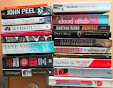
Discussion at Hare & Hounds, Lansdown, 2nd June 2016
Neil opened the evening with a quick check on how many people had finished the book and a disappointing 3 out of 8 was the answer, this did not bode well, but surprisingly, despite that we still found a good deal to talk about, even if it was just the simple question of why so few had finished it.
Neil's own view was that it was clearly not the easiest book to read, partly due to the frequent use of Jamaican Patois, partly due to the punctuation and sometimes due to the way the author sometimes employed a stream of consciousness style to convey the thoughts of the protagonist being heard at the time. Coupled with these factors was the sheer length of the book which would not have necessarily been an issue on it's own had it been an easier read (as someone pointed out, Somerset Maugham's book was much longer but everyone finished it). However, he felt that a lot of the issue was with the prolonged first section of the book leading up to and dealing with the assassination attempt on Marley, which he thought went on much too long and included far too much unnecessary commentary. For him for example the long sections with the CIA characters were superfluous and after this first chapter they barely warranted mention again in the rest of the book. OK, include mention of them, but not all the detail that they brought with them.
After this first part Neil found the pace of the book picked up considerably and became more entertaining. He did continue to find parts of the book which could have done with heavy editing, perhaps cutting out some of the graphic sex scenes for example, but the "chapters" based in the States whipped along much quicker. A dichotomy were the parts featuring Dorcas (formerly Nina), where her escapades caring for a man who has a form of Alzheimers seemed similarly unnecessary, but Neil was happy to read these as he found them well told and a pleasant diversion from some of the darker gangland scenarios.
Richard had also finished the book and agreed that it could have been much shorter, but disagreed about which parts he would have cut. For him Dorcas's part being cut out would have been no loss. As we know Richard likes to discover characters with whom he can empathise, and here he found none, even though one or two of the characters were quite interesting, not least of which was Jamaica itself. He also enjoyed some of the historical detail.
However, for Richard the book was difficult to read, too long, too many of the characters were indistinct, there was too much physical and verbal violence and, despite that fact that he LOVES reading about sex, for him there was too much of it in this book. Overall, it didn't do it for him.
Chris B was only about half way through the book (51% in Kindle terms), but despite that was more positive about the experience. He concurred that it had been hard to get into, but felt that the novel repaid that effort from the reader and became more and more engaging. In particular he found the technique of giving an individuals POV right up to the point of death was fascinating and well done. He also thought that the descriptions of how people were exploited and abused, both by gangs and by the politicians, were well done and convincing. He has enjoyed it so far, maybe he will comment further when he's finished.
Mark T on the other hand hated the book. He couldn't get into it and had only read 10% of it, feeling that he had got a pretty bad deal spending money on a book that he felt it extremely unlikely he would ever finish. It reminded him of an experience in his NHS choir where they were singing African songs where he naturally didn't understand the words they were singing which he found incredibly frustrating and for him the language just made the book too inaccessible.
Chris W had got a bit further (21%) and had actually enjoyed the bits that he had read, but again had found it just too hard to get further with. It simply required too much concentration when he was reading late in the evening, even though he liked the use of the vernacular language. Despite this he was immersed into Jamaican street life and found the insights into the gang culture and the oppressed role of women quite interesting. He also enjoyed recognising all the cultural references which he remembers from the time, but it is debatable whether he will get around to finishing it.
Steve had got further still (30%) and suspects that with the next book promising to be a lighter read altogether, he may yet find the time to see it to the end. He appreciated the skill of the author to talk in so many different voices. He liked the humour that existed in it and although he has struggled with the book so far, still thinks that it may have the makings of a great book....watch this space for updates.
Mark W had asked to be the last to contribute comments on the evening and this was because he had quite a personal connection with the subject matter having been born in Jamaica. Although he moved from there when he was still an infant, he still has numerous family connections and has made several visits back over the years. Indeed his cousin was lawyer to the real gangster portrayed as Josey Wales in the book, and was married for some time to the mother of Bob Marley's son who Mark knows quite well. Consequently the one thing Mark didn't find hard was the language and indeed he agreed to read a passage of Patois which he managed very successfully to a small round of applause. So it was interesting that despite this Mark still found the book hard work and only finished it a couple of hours before the meeting.
Mark found the book interesting, but not enjoyable, and often found himself questioning what the point of the book was or who it was aimed at. Even though he was familiar with a lot of the details, he couldn't see why they were fictionalised in the way they were and was also left constantly wondering which bits of the book were true and which weren't. He also couldn't relate to any of the characters and was mostly just interested in the context and setting. He too also disliked the graphic gay sex (especially as he found it highly unlikely that this would have been tolerated in any way by the gang members fictionalised in the book) as well as with the fact that the book is marketed as being about Bob Marley when it patently isn't. He lost patience with the US section. On the plus side he appreciated the painstaking research that must have gone into it and found two elements noteworthy: firstly the section from Bam Bam's POV that is written in verse and secondly the use of the ghost Jennings to provide a unique perspective.
Rob had mailed in his thoughts before the meeting and had similar feelings to others. Firstly that the language just slowed down the reading process. Secondly he echoed Richard's comments that the misognyistic attitudes and inherent day-to-day violence were hard going to read. However, what has kept Rob going (he was about 30% through at the time of his email) was his interest in the time and place, especially the personae of Bob Marley and Malcolm Manley and the different perspectives the book is giving him on them. The reference also to a book (Soul on Ice by Eldridge Cleaver) that may have passed many of the rest of us by, made a big impact for Rob as this was a seminal work of great importance to him at the time.
So far then Rob is enjoying the book for its social and historical comment and he is fascinated to find out what happens to the various players in the narrative. Whether he will still be having read this blog remains to be seen!
Overall a lively discussion considering the few people who had finished the book which included an interesting debate about the Booker Prize and whether or not it's judges really work on literary criteria or just on box ticking for the purposes of proving how appreciative they are of diversity in all its various forms.
Monday, 6 June 2016

Sunday, 3 April 2016
Dark Matter by Michelle Paver
Discussion at The Pulteney Arms, Bath, 3rd March
2016
The book was chosen for several reasons: firstly, a long
time had passed since the club had read a book that placed itself in the ‘ghost
story’ category (if indeed we ever have); Michelle Paver is familiar to a
couple of us through reading her well-received ‘Wolf Brother’ series with our
children a few years ago; and as quite a short book it could be a not unwelcome lollipop
contrast to the recent run of fairly lengthy tomes.
To cut to the chase, there was general agreement that the book didn’t really
match up to the 'ghost story' billing. It wasn’t without its qualities and most of us found
something to like, but overall there was a distinct lack of, um, ghostliness.
Jack, the protagonist, is followed through the story largely
by means of his own diary. He joins an expedition to spend a winter in the
Arctic on a remote part of Svalbard (Spitzbergen). He doesn’t really fit with
the public school background of his expedition mates but they need a radio
operator and decides to go anyway as it fits with his own (so far thwarted) greater
ambitions. On his way back to his digs after the interview, he witnesses the rotting corpse of a
drowning victim being recovered from the Thames…
Months later, and already a man down, the ship carrying them
north nears Spitzbergen and it becomes clear that the experienced, quite possibly grizzled
skipper is reluctant to transport the expedition to the exact location that
they originally planned – but why…?
We liked:
Effective, sometimes dramatic descriptions of the location, weather and and
scenery; the ice ‘talking to itself’; the loneliness enhanced by the weather,
the effects of the increasing cold and shortening daylight. The rigmaroles
involved in setting up the radio and the details of the paraphernalia (such as an Austin
car engine used as a generator) involved in establishing polar expeditions of the 1930s. There was atmospheric build-up in the
description of the mysterious ‘bear post’ outside the hut and the description
of bay and what had been left behind by the previous inhabitants. The employment
of distraction therapy to reduce Jack’s feelings of fear; the panicking description
of getting lost. We all found it an easy enough read and one of us was even prepared
to admit that it kept him reading later into the night than usual.
We didn’t like:
The curt and over-dramatic language used at the start of
almost every chapter (‘It’s all over, I’m not going’… ‘Jack what the hell are
you doing? What the hell are you doing?’…‘I’m still troubled by what happened,
so I’m going to try to get it straight’…‘Now I really know I’m in the Arctic’…)
- much more suited in style to a book for young teenagers but to grizzled
adults it became tedious quite quickly. So it was hard to buy into this as an adult book. The diary format wasn’t entirely plausible, as his entries would
be surely be more technical and less emotional. Some of the plot required too
great a suspension of disbelief – setting the hut on fire and then being
rescued; the relationship with Gus and the rather ‘corny, trashy’ passages
addressed by Jack to him. The ‘contrived’ nature of the plot development (such
as the one-by-one picking off of his expedition-mates by circumstances rather
than nefarious means) meant that the further we went into the book the
less we really cared. And for more than one of us there was a blatantly missed opportunity for some fine polar-bear-based jeopardy.
What we thought:
A horror film creates its suspense through the ability to totally immerse its audience in the narrative and visual aspects of the story. In this screen-dominated era, it’s a
harder accomplishment to pull off in a book, and on the whole we didn’t feel
that Dark Matter managed it. One of us felt it was ‘scary at times’ but others
weren’t so sure. There was a fairly engaging setup but the leaps we
had to make to buy into the climax of the book were too great. Henry James’
‘The Turn of the Screw’ was mentioned as an excellent example of a well-written
story that effectively creates suspense. In terms of describing the trials and
hardships of early 20th Century polar exploration, the account of
Shackleton’s expedition read by the club a few years ago was cited as a better
stab (though I’m not sure all of us would entirely agree with that!).
Essentially we felt it was more of a teenager’s book than we
were expecting, easily consumed but a bit disappointingly insubstantial as a
result, and while it had potential it wasn’t on the whole lived up to.
One score still to come in but otherwise a very consistent
set of scores between 5 and 7. Average 5.5.
Sunday, 13 March 2016
Of Human Bondage by Somerset Maugham
Warning! This is a long review as we all had a lot to say about the book!
Much to all our surprise, this book met with almost universal
acclaim, even love, despite its length and age. Those who missed the discussion
or who had not finished the book are even suggesting a further conversation on
it at a future meeting. Unheard of in the Club! Mark T: “It was one of the best
books I have read for a long time and I was picking it up to snatch a page or
two every spare moment.” Chris W: “I really enjoyed reading this book which is
one of the best I feel that the club has read in the last few years”. Richard:
“unlike the last perfectly nice, very readable, book we read, this WAS a book
which addressed (very strongly) matters which are central to the human
condition; and which had a number of well-drawn characters, with many of them
drawn in some depth. I enjoyed the book a lot. Very occasionally, some passages
did not hold my attention, but overall, the book held my full attention
throughout – it was strong on both plot and character, and of course huge
amount of historical detail; plus major discussions about philosophy, art, and
‘the human condition’.” Rob, however “found the book profoundly irritating in
many ways and it was vastly too long a book for any substantive content that it
did possess.”
This is a largely autobiographical book that finishes when
Philip, the main character in the book reaches the same age (about 30) as the
writer was (thanks, Mark W for this and many other biographical nuggets).
We get to know Philip as a character, warts and all. He is
very ready to be open about his weaknesses and prejudices whilst avoiding any
tendency to make us feel sorry for him facing really difficult experiences in
his life, as an orphan, a disabled schoolchild, an anxious adolescent and a not
very good artist and scholar. We all felt engaged and interested in his life
journey even if we did not necessarily “like” the character.
The book takes us from the death of his mother, though
living with his childless uncle and aunt, school, including the thinly
disguised Kings School Canterbury, through various career moves as a clerk, an
artist in Paris, a medical student and a down and out. At Kings, Somerset
Maugham is celebrated as a famous old boy, even though he hated his time there
(as implied in the novel). Mark W and Steve loved the ending [spoiler alert]:
he lowers his ambitions for a spell in Spain when he decides it is time to
marry his friends and settle down, despite not being in love.
And the bondage? A lot of the book describes his close
relationships with women, the older woman, the “unsuitable” but captivating (to
Philip at least) waitress, the stalwart friend and the sensible young daughter
of his friend. He is for much of the novel, enslaved to his desire and obsession
with Mildred, the waitress. But the bondage is also reflected in his frequent
musings on life’s purpose and meaning (or lack of it). We all live our lives
with energy and emotion, fully bound to the business of living: to what end?
Another take on this from Chris W: the recurrent theme
throughout the whole book and presumably the principal "bondage" that
Maugham was talking about is wealth or lack of it. What are the different
"bondages" that Maugham was referring to at the beginning of the
book? I thought he was referring simply to his physical disability but it was
clear by the end that the whole social system at the time in Britain was
intended. Philip and his friends are constantly considering how they can
survive for the next few years, months, days and there are numerous references
in the book demonstrating how difficult it was in those times to change career
or to finds new employment at all and how there was a hierarchy for everything.
Predicting the longevity of one's parents and any possible inheritance seemed
to be a frequent consideration. The most terrible example of this is depicted
in the downfall of Mildred who ultimately ends up in prostitution.
The mixture of the development of a life and lives of an individual,
personal relationships, character development, story telling, creation of place
and time with the many musings on life and morals is what makes this book so
engaging. As Richard says, “I do not think I have bookmarked or highlighted so
many quotes in any other book”.
Chris W: I understand that this was partially an
autobiography so it was very evident how Maugham's early childhood being
brought up by his uncle and aunt in a very austere and unloving relationship
had affected him (and Philip) severely throughout the story and it was this
lack of love Philip explains that gives him the ability to see things in a
different way. His experiences of being sent away to a boarding school and then
bullied because of his leg are very sad. (I have to say that my experience of
being sent away to a prep school at age 8 I had several similar experiences as
the new boy had to be bullied as of norm and it was the right of the older boys
to do so).
Richard: in so many ways, Maugham nailed this character so
well – how as a naïve youth he gets taken in:
“"Of course the man's a pedant. He has no real feeling
for beauty. Accuracy is the virtue of clerks. It's the spirit of the Greeks
that we aim at. Weeks is like that fellow who went to hear Rubenstein and
complained that he played false notes. False notes! What did they matter when
he played divinely?" Philip, not knowing how many incompetent people have
found solace in these false notes, was much impressed.”
How embarrassed he is, so easily:
“He pictured himself looking out for Miss Wilkinson, the
embarrassment of going up to her and asking if it were she (and he might so
easily address the wrong person and be snubbed), and then the difficulty of
knowing whether in the train he ought to talk to her or whether he could ignore
her and read his book.”
How difficult it is to go through with potentially
embarrassing things:
“He would willingly have bolted, but he was afraid of the
remorse which he knew would seize him. It was like getting on the highest
diving-board in a swimming-bath; it looked nothing from below, but when you got
up there and stared down at the water your heart sank; and the only thing that
forced you to dive was the shame of coming down meekly by the steps you had
climbed up.”
Rob found the character of Philip irritating: “he needed a
really good slap around the face. He was the most pathetic and insipid
character I can ever recall reading about as the central person in a novel. For
me, no historical 'of its time' explanation can forgive his self indulgent
destruction of his own life - and no, having a club foot or being an orphan
doesn't excuse or explain it either. (Or to put it another way, if those things
were the explanation, then the author should have tried communicating that in a
more than simplistic way).”
Chris W: I enjoyed the contrast of Phillips liberating
experiences in Paris and all the different people he met and the result being
that he no longer believe in Christianity and could look upon life in a
different unprejudiced way. There is a really good bit where Philip comments
that the masses follow the rules and regulations of the state being rewarded
with medals pensions and honours if they comply whilst the individual is able
to travel freely observing things for themselves avoiding already in existence
package holidays arranged by (Thomas) Cooks!
Mark said: I really enjoyed the Paris section and it
reminded me of my younger days in Bath when I used to go to art classes in
Sydney place - it was great with the smell of oils and all these young artists
discussing art. I was rubbish of course but like the book there was a girl like
fanny who took an interest in me and helped me with my strokes. Unlike Fanny
she was very beautiful and was called Becky. I got to know her quite well. Anyway
the interesting bit was that 30 years later I find that she is a near neighbour
of mine living the other side of my road!
The book is easy to read but never loses interest (though sometimes
you could kick Philip for being caught yet again by his attraction to Mildred).
It manages to mix description, reflection and dialogue in a thoroughly enjoyable
mix. Neil felt it slowed down rather when Philip comes back to London from
Paris and some of the expressions Maugham uses now seem curious and stilted.
Some things that happen appear nonsensical. There were extremes of
relationships with some people being walked all over and others not.
Mark T: the poverty bit was very gripping and interesting
and I really felt for him.
Chris W: Philip's coming of age story and his progressive disillusionment,
pain and disappointment in life over the next 10 years show how much has now
changed. It is amazing that in the 100 years since the book was written society
has changed to what it is now with the freedoms and flexibilities and welfare
support that are available to our adults and children. I think therefore this is
an excellent book that should be read by every teenager when considering life's
options (Particularly if considering taking up a career in accountancy).
Some of the themes that resonated with members the club were
the full immersion in religious belief (including the belief that faith can
heal his club foot) and the subsequent rejection of it, class relationships
(for example, when Philip is a gentleman amongst the clerks), how you can fall
in love and then suddenly fall out of it (e.g. when Philip sees how old Mrs
Wilkinson looks), how you can become infatuated and repeat your mistakes. It
certainly showed how the class system increased or decreased your access to
professional roles (doctor, accountant). Is this still the case if to a lesser
degree?
Rob was dissatisfied with the book’s portrayal of society: the
book had the potential to be an important social commentary - but failed to be
that. It dipped its toe into important issues around class division, the place
of work, healthcare and housing - but gave little more in response beyond
platitudes that were driven by the author's own middle class perspectives. It
could have provided interesting debate on any of these topics but instead left
us with little more than homilies about the stoicism of the working class, a
side swipe at the thuggery of early trade unions and an assertion that honest
work solves all problems of poverty (George Osborne rules, OK?).
Chris W: interestingly throughout the book there are many
many instances where individuals do not succeed with their aims for one reason
or another. It seems that the common view was that anyone not achieving their
initially stated career e.g. becoming an artist in Paris, an accountant in
London would likely fall into abject failure, alcoholism and ultimately death.
Keeping one's life on a career path was therefore much more precarious and
alcoholism was always just round the corner if one failed.
Richard: so many observations are so acute:
“She looked at him quickly and flushed. When she reddened
her pasty skin acquired a curiously mottled look, like strawberries and cream
that had gone bad.”
“It was very curious. Away from her he thought her
beautiful, remembering only her magnificent eyes and the creamy pallor of her
face; but when he was with her he saw only that she was flat-chested and that
her teeth were slightly decayed; he could not forget the corns on her toes. He
could not understand himself. Would he always love only in absence and be
prevented from enjoying anything when he had the chance by that deformity of
vision which seemed to exaggerate the revolting?”
“Sometimes great philosophers seemed to have nothing to say
to him, but at others he recognised a mind with which he felt himself at home.
He was like the explorer in Central Africa who comes suddenly upon wide
uplands, with great trees in them and stretches of meadow, so that he might
fancy himself in an English park. He delighted in the robust common sense of
Thomas Hobbes; Spinoza filled him with awe, he had never before come in contact
with a mind so noble, so unapproachable and austere; it reminded him of that
statue by Rodin, L'Age d'Airain, which he passionately admired; and then there
was Hume: the scepticism of that charming … the thought of each philosopher was
inseparably connected with the man he was. When you knew that you could guess
to a great extent the philosophy he wrote. It looked as though you did not act
in a certain way because you thought in a certain way, but rather that you
thought in a certain way because you were made in a certain way. Truth had
nothing to do with it. There was no such thing as truth.”
“The thing then was to discover what one was and one's
system of philosophy would devise itself. It seemed to Philip that there were
three things to find out: man's relation to the world he lives in, man's
relation with the men among whom he lives, and finally man's relation to
himself. He made an elaborate plan of study.”
“The advantage of living abroad is that, coming in contact
with the manners and customs of the people among whom you live, you observe
them from the outside and see that they have not the necessity which those who
practise them believe. You cannot fail to discover that the beliefs which to
you are self-evident to the foreigner are absurd.”
The health service in those days was really interesting:
“"If you can afford to wear jewellery you can afford a doctor. A hospital
is a charitable institution," said Dr Tyrell. …. "I don't care a hang
about your letter; you get out. You've got no business to come and steal the
time which is wanted by the really poor."
His account of addiction: “Why don't you give up
drinking?" "Because I don't choose. It doesn't matter what a man does
if he's ready to take the consequences. Well, I'm ready to take the
consequences. You talk glibly of giving up drinking, but it's the only thing
I've got left now. What do you think life would be to me without it? Can you
understand the happiness I get out of my absinthe? I yearn for it; and when I
drink it I savour every drop, and afterwards I feel my soul swimming in
ineffable happiness.”
“Philip thought of the countless millions to whom life is no
more than unending labour, neither beautiful nor ugly, but just to be accepted
in the same spirit as one accepts the changes of the seasons. Fury seized him
because it all seemed useless. He could not reconcile himself to the belief
that life had no meaning and yet everything he saw, all his thoughts, added to
the force of his conviction.”
There were some poignant moments too e.g. being alone on
Christmas day
We discussed Maugham’s attitude and description of women. Mark
W pointed out his physical and psychological portraits of even the women he is smitten
by is not at all flattering, quite the reverse. They are not rounded characters
(Neil). Whereas he describes many of the male characters much more positively.
Does this reflect the challenge he faced in being homosexual (who was married
for 12 years)? Is this misogyny a reflection of the times Maugham lived in?
Rob felt all the main characters were lacking: I felt every
substantive (certainly male) character was highly self-centred. Their
definition of the meaning of life and fulfilment was all about themselves. Whether
that is about blatant self-interest or slightly more subtle narcissistic
behaviour, the men in this book were only interested in themselves and their
own self-gratification. If this book was trying to explore what drives human
behaviour, then looking buying self-interest might have been a factor to
consider. The concept of deriving meaning in life through contributing to the
wellbeing of others rarely got a glimpse in any character development. There
were one or two (female) exceptions to this such as Norah and Sally, but the
female characterisation was so (of its time?) simpering - other than the
somewhat psychopathological (is there such a word?) Mildred - that this
compounded the sin of not making people more rounded characters.
Rob, in trying to find positives, quite liked a couple of
characters (Cronshaw and Athelney), the descriptions of the early health
system were interesting and every now and then a social vignette (e.g. the hop
picking) worked well. Beyond that, whilst I started out thinking that there
were some perceptive commentaries on the human condition, I ended up feeling
they were so driven by the authors own need to self-justify a belief that the
only satisfactory outcome in life is to reject creative passion, as it leads to
squalor and degradation, and instead accept that the only true course in life
is mediocrity and 2.2 kids (or 7.2 in late Victorian times) that I found myself
increasingly rejecting those potential pearls of wisdom.
Mark T again: The Mildred section was very sad and gripping
in that someone who does not want you seems very desirable. But when she
finally almost wanted him he does not want her. Nearly caused the ruin of him. Of
course the other woman who wanted him - Nora, he did not want. Very
interesting. The friendship with Sally was interesting and the way it slowly
matured. A woman whom he likes but not passionately might be more secure for
him which might be true. I did not notice that he had [had sex with] Sally -
must have been in the hop fields. I thought the bit at he end where he thinks
she is pregnant and therefore has to give up his travels and then when she is
not, he is sad he does not have an excuse - classic I thought. A lovely ending.
Chris W: I'm afraid I didn't quite understand the
relationship with Mildred. As the story progresses I was irritated when she
keeps reappearing and Philip is unable to avoid getting involved with her
again. I didn't quite understand this "love" that brought him to
continually seek to remain in a masochistic relationship with her. I didn't
also understand Philip's lack of sexual interest in anyone he ever met even
though they might be unattainable. One would've thought that with his time in
Paris he would've become more liberated sexually but instead he continues in
London to have a most complicated and repressed relationship with a woman who
he admits later no longer attracts him. Clearly he is very sensitive about his
leg however as the book goes on he seems to be freed from concern about this
and yet even when working in the department store he seems completely
disinterested in anyone he works with. I was beginning to assume that the book
was leading towards Phillip's discovery of homosexuality but it is only at the
very end that he finds love with Sally which is then not described but left for
one's imagination. (Did anyone else think of Darling buds of May and Catherine
Zeta Jones)?
Rob had a similar issue with the romance: I know interaction
between the sexes was different 70 years before we were starting to do it, but
this concept that people fell hopelessly in love with someone within two hours
of meeting them, to the extent that they then compromise their entire future
life by behaving in unhinged ways, just isn't real. Speaking personally, when
I've fallen in love it's because a woman has given a good and positive reason
for me to react that way - even if in hindsight I exaggerated or misunderstood
it. No plausible reason was ever given for Mildred causing Philip's reaction -
to say nothing of other occasions when one person declared profound love of
another at the drop of a hat. If that's how the Victorians behaved then they
deserved every negative thing that ever happened to them in their personal
lives.
Intriguing questions include whether Philip consummated his
love with Mrs W (making love did not necessarily mean what it does today). We
had a interesting discussion on this: everyone apart from Mark T thought that
Philip had had sex with her when he locked the door - Mark thought they only
kissed and caressed each other. Mark came across a section later on in the
Paris section when he was drawing a naked women - he was embarrassed as this
was the first time he had seen a naked women. Maybe Mark was right or maybe you
do not need to be naked to consummate a relationship?
Richard: I could go on, but I won’t!! A really good, interesting, valuable and
generally gripping book. I can’t say that I liked, Philip, but somehow that
didn’t matter here – I certainly felt sorry for him, and I’d have been happy if
the book had been twice as long, as I’d like to follow his life on for the next
30 years.
Chris W: in conclusion this was an amazingly clear
representation of English life at the turn of the 19th century and the complex
customs, class, morals and prejudices that prevailed in an environment where
without social support of any sort everybody was so much more aware of their
financial position and the inevitable "drunkenness” or "prostitution”
that would result if their money dried up. A very interesting book well worth finishing
as it was so abnormally thought provoking.
Scores
Mark T 8.6
Richard 8.5
Mark W 8
Neil 8.3
Steve 8.5
Chris B 8.5
Chris W 9
Rob 5.8
Sunday, 17 January 2016
Night Circus by Erin Morgenstern
Described at the time of the book being proposed to the bookclub as a mixture between Philip Pulman, Harry Potter and Kafka on the Shore - indeed those being the reasons it was proposed - Night Circus by Erin Morgenstern received a largely lukewarm reception from the BBBC’s reading public. The story of two ‘magicians’ using their youthful pupils to fight a battle over their respective approaches to how they use their powers, in the setting of a circus (which isn’t really a circus), and which is essentially a love story, failed to capture the imagination of all bar one of us. Indeed perhaps the most fundamental question (and reason for the 6 v 1 difference of opinion - with one judgement outstanding) was whether there was anything more to Night Circus than it being a love story with some clever imagery (and a bit of disconcerting child abuse). More of that later.Most found the book difficult to get into, with it taking a substantial number of pages before anything really grabbed attention. Mark T (whose final opinion is still to come) was most extreme in this, having several failed attempts before finally cracking it and (at the time of the meeting) looking forward to finishing the book. Others though, continued to struggle somewhat. It was not that people were finding it a difficult read, but rather that it lacked depth for them. Steve, for example, described it as being as though the book had been started when Morgenstern was in the sixth form but the writing had never really grown up. Chris W. felt there was not enough story to keep him interested whilst Chris B. described it as a triumph of style of substance.Nonetheless, there was a consensus that the author had created some vivid images, with mystical descriptions and even Neil (possibly the person most critical of the book) said how “in a weird way it became believable, I became absorbed by the world it created - but the narrative didn’t work”. Few characters other than Bailey got positive reviews. There was the usual difference of opinion about the way the chapters jumped between dates. It irritated some (“It’s just trendy to do it”) but was fine with or even liked by others. Other concepts resonated with some, for example Chris B liked the descriptions of becoming a camp follower and also the gradually falling apart institution - both of which he felt were true to life. Overall, the general view was perhaps summed up by Richard’s damning with faint praise line of "a perfectly nice, very readable book, but certainly not an amazing one".This takes us into the one dissenting voice from this analysis (i.e. Rob) who had read the book twice because of a suspicion that there was more going on in it than might appear on the surface. Whilst accepting it may just be no more than a love story, he also suggested that Morgenstern was perhaps trying to make various societal or behavioural points: the two different ‘schools’ of magic representing a battle between the physical/material (Celia) and the psychological/spiritual (Marco); it could be an allegory about two powerful people (Prospero and A.H.) manipulating society and what happens when people try to break free; or a description about what happens when you allow an idea to take you over to the extent that it risks destroying not only you, but also others. He felt the short ‘interludes’ between chapters (set out in different type-set formats) also contained some important and interesting homilies - for example, the importance of story-telling to take knowledge and understanding through society and generations.On the other hand, as Neil said, it could just be that he was “imbuing more meaning into it than it merits”.The overall score was a middling 6.68.
Monday, 7 December 2015
Life After Life, by Kate Atkinson
The Forester and Flower , 3rd December 2015
Chris B opened up proceedings by saying that he found there
to be lots of good things about the book. An interesting family, although
it was a shame about the parents’ relationship, but the author conveyed the
truth behind many relationships of the time no doubt. Chris really got into the
book when it described the Blitz which he found well described and relevant to
his own family background. He found the overall concept interesting, but
occasionally confusing. Ursula didn’t seem to truly develop as a person
and never fully engaged in relationships. A mixed experience for Chris
but overall positive.
Chris W was also absorbed by the Blitz descriptions and how
vividly they portrayed the impact of a bomb blast for example, and enjoyed the
way in which certain key eras of English history were brought to life. He
found himself a little nostalgic for some of the rather old-fashioned turns of
phrase that were given a new lease of life here but that you don’t hear any
more. However, at the same time he didn’t always get the point of the book and
occasionally found himself waiting for some profound revelation that never
came. Was the book challenging the question of “what if’s” in peoples
lives, or just a collection of short stories?
Steve was more effusive and found the book “mostly
brilliant” in the hands of a very skilled writer. He too thought the Blitz
descriptions were very strong and powerful, and the passage where an apparently
intact body came apart like a cracker when they tried to move it stuck in his mind.
He wasn’t exactly sure about the way the different lives were addressed, but he
did feel it gave a really different perspective on those lives that made them
somehow almost three-dimensional. In his opinion it was a great social
/historical commentary; descriptions of Clarence and his tin face for example
reminded one of how commonplace such sights must have been. He wasn’t convinced
by the Hitler segment and felt it unnecessary and indeed it showed signs of the
author trying to be over-ambitious perhaps, but overall enjoyable.
Mark T on the other hand didn’t find this a very good
book. For him it was tedious re-reading the night of Ursula’s birth
multiple times. He did find the horrendous male relationships
fascinating in their awfulness and was intrigued by the rape carried out by the
American, with it’s almost unbelievable speed and location. He too felt
the German part didn’t work and overall simply wasn’t gripped by the book.
Rob felt similarly to Mark here to the extent that he hasn’t
finished the book and still has some way to go with it. His fundamental
problem was that he had loved The First Fifteen Lives of Harry August and so
LAL was not comparing well in his eyes. In fact probably the most interesting
thing for him was that two authors should come up with the same general concept
and write novels about it within such a relatively short period of time when,
to his knowledge, there were no other well known novels on this theme at any
time before (Neil notes that they were published within 6 months of each other,
with LAL coming out first). So Rob discovered that reading this on his iPad,
the Sports news was regularly proving more of an attractive read than the
novel. And he did ask for it to be noted that he had enjoyed the
music…the live music playing in the other bar of the pub.
Neil was more enthusiastic about the book having found the
atmosphere and the characters very lifelike and easy to be drawn in to.
He liked the way that Atkinson explored the sliding doors idea of how much your
life could change if you handled small and short-term incidents differently and
for him the most powerful example was how in one version of Ursula’s life she
allows herself to be kissed by the American boy on her 16th birthday
and this ends up with her being battered to death by her monster of a husband
while by merely kicking the yank in the shins when he advances on her it
completely changes the course of her life. A salutary lesson for those
who chose to deny the terrible impact that rape can have on women’s lives,
especially in society’s like Ursula’s where the shame was deemed to be so
terrible. There were times when he questioned whether a normal person
would have had quite so many opportunities to die, even without the Blitz to
contend with, and he too found the Hitler element unnecessary, but overall he
found the writing style and descriptive ability to be very absorbing.
Richard shared his view via email and concluded that on
reflection the book had been good, but certainly not amazing. In contrast
to Rob he found it much better than FFLOHA which he thought somewhat trite and
dull. By comparison LAL unfolded lots of different possible futures, the
Blitz was well handled, he felt he got to know Ursula and the family and
sibling dynamics were fascinating. He also liked the idea that Ursula was
bearing witness to the 20th Century. On the downside Ursula
seemed a rather vague and un-developed character at times and that the author
hadn’t been completely sure of what she was going to do with the re-birthing
idea until the end of the book.
Mark W added via email that he found the book rather
hard going. There were parts that he enjoyed, particularly the extended
descriptions of London in the war which she brought alive very well. However,
the book as an entirety didn't convince him and he found himself getting
irritated by the rebirths. Yes, the concept was interesting but ultimately
pointless and he found himself thinking what a better book it would have been
if she had just made it a straightforward narrative; not as clever but probably
more enjoyable. She could have then ditched the Hitler bit which he found
rather silly and unconvincing
We enjoyed meeting in the Forester and Flower and although
the live music playing next door was sometimes a little intrusive, it was quite
good on the whole and added to the evening’s entertainment!
Thursday, 5 November 2015
Under the Skin by Michael Faber
Mark W introduced the book by saying that he had recently
seen the film and was left with a ‘what on earth was that all about’ feeling,
and therefore hoped that the book would
fill in the gaps. He also did not expect that this book would have been the one
of the four proposed that was the majority choice, being the first novel of a
relatively unknown Scottish writer. Although not wanting to reveal his view of
the book at this stage one point he wanted to make was that the book and film
were significantly different in narrative and emphasis.
Steve opened the discussion by saying that he enjoyed the
book from the beginning, that it was an easy read and well paced without being
particularly challenging. It raised questions from the word go, and the gradual
build up to the revelation was well handled. In the end he wasn't really sure
what the book was actually about and wasn't sure that it actually reached a
conclusion but was happy to be drawn wherever it took him. One minor
frustration was the lack of background as to how and why the aliens got to
Earth in the first place (a theme taken up by others to a greater or lesser extent).
Rob followed by saying that he wasn't sure what he though
about the book. The elements were quite clear, the images were good and there
was originality in the concept of the aliens being the humans. However he had
two big problems. Firstly the credibility of the story: he felt that the continued
disappearance of the hitch-hikers would have been followed up more and this
caused him some irritation. Secondly, although the book introduced a lot of
interesting ideas he felt the that lack of background on how the aliens got to
Earth in the first place was a major negative and he was left wanting to know
more about where they came from. Overall he just felt that there were too many
gaps. Unlike Steve however, Rob liked the ending.
Chris B did enjoy reading the book. He suggested that there
was a flavour of ‘Never Let me Go’ in the sense of the gradual build up to a realisation
of what's actually going on. He did like the way in which the human and animal
concept was turned on its head, and was happy to go along with the book’s own
internal logic. However there were also some unsatisfactory loose ends. In
particular, the whole issue of where she came from and why she had to go through
this experience. He felt that he wanted to know more about her but he also
though that the relationship with Amlis was handled well. It was also an
interesting observation on the sexist nature of men.
Mark T was also frustrated by the lack of background, and
had problems with particular detailed elements of the book, including why she
had to live alone in the house and the over emphasis on her physical attributes
during the meetings with the hitch-hikers.
Richard thought that the book was excellent. He thought it
imaginative, coherent and, unlike some of the others didn't feel that there
were any gaps. He was happy with the fact that the book did not go into too
much detail about where the aliens came from and he felt that the information
given was sufficient. The style was distinctive, original, lyrical and
brilliant. He finished the book two weeks before the meeting but remembered
every detail. He identified with and was able to understand Isserley and was impressed with the depth of
characterisation. He cared about her and understood why she was embittered. He was amused at the
shock that she felt at the idea of eating sheep. An assured piece of work.
Neil, although he was prepared to accept the concept of the
aliens, was less prepared to accept that no one missed the disappearing
hitch-hikers. He thought that the aliens, with all of their technology, would
have figured out a more efficient way of resolving their nutrition problem. He
found Isserley dull as a central character, but found some of the interactions
interesting. The concept of us being the animals was not very subtle. Like others
he found the background story a bit unsatisfactory, and the character of Amlis
a bit of a cliché. He felt that the ending was a cop out so overall, although
he wanted to like it, he was left feeling disappointed.
Chris W was not disappointed. He felt that there were so
many different ideas and enjoyed the whole concept and the frequent events that
occurred. He thought that the underground imagery was powerful but was
disappointed that the relationship with Amlis didn't go anywhere. Like Neil he
felt that the ending was a cop out. Overall, although the book had its faults,
he felt that his mind had been stimulated.
Mark W concluded the reviews by saying that he enjoyed the
book, finding the concept original, and the characterisation of Isserley, upon
which the book really depended, was convincing. He did not have a problem with
the lack of detail of the alien world, and indeed, felt that the bits of
information given were sufficient and appropriate, as more focus here would have
detracted from the actual focus of the book. He found that the descriptions of
Scotland were evocative and powerful.
The horror of some of the underground descriptions was not too explicit, i.e.
it left much to the imagination although the some of the images remained in the
mind. Yes, there were flaws, but overall he was drawn into the world created by
the book. Finally, although very different from the film, some of the gaps and
questions in the latter were explained by the book.
Monday, 19 October 2015
The Sunrise, by Victoria Hislop
The Hare and Hounds October 1st 2015
The fact that we avoided talking about the
book for so long and even let Chris W riff about new developments in drone
selfies tells you how high the level of eager anticipation was to re-live the
pages of The Sunrise.
Neil kicked off by reminding everyone why
he had chosen the book in the first place, and what a good book he had thought
The Island had been when he read it several years ago. He even tried to deflect some of the blame
for choosing it by reminding everyone that he had not chosen the Louis de
Berniere book because Chris W had already read it…but no one bought that
excuse, particularly Chris.
Neil’s overriding feeling was one of
tremendous disappointment that such a potentially interesting idea, that one town
on Cyprus should have been divided and abandoned and maintained as a patrolled
ghost town for 40 years, had then been mined so poorly with such poor
characterisation, poor writing style and wooden plot lines. Clichéd personae and descriptions seemed to
draw on soap opera style dramas of the 80’s such as Dallas. Only the fact that the pace picked up in the
second half made it readable, but then it accelerated to annoying light speed
for the last quarter. The only redeeming
feature he found was that he was slightly more enlightened about the history of
what happened in Cyprus at this time, but only slightly, and he found the
Epilogue perhaps the most interesting part of the book.
Chris
would have preferred a 30 page synopsis that could have saved him having
to read the whole book and found the characters tedious and paper thin. Somehow he finished it but was still left
wondering why Neil didn’t choose the de Berniere instead.
Richard particularly agreed about the
characters not even being 2 dimensional, but barely 1 dimensional. The plot was transparent with the possible
exception of the murder of Marcos. He
found it easy to read and reasonably well paced, but at the same time very
stilted with the language lacking any precision. A terribly mediocre book that only succeeded
in teaching him a tiny bit about Cyprus.
Mark T had enjoyed visiting Cyrpus and was
looking forward to the book until his wife warned him that he would hate
it. It reminded him of reading terribly
written stories in Womans Weekly when he was an adolescent !(well…. didn’t we
all…..????)
Steve meanwhile wondered how a book like
this got past the editorial process and had concluded that it had been rushed
to meet a deadline. He managed to find
some interest in the book when Aphroditi discovered another woman wearing her
jewellery but was dissatisfied with the fact that this was not properly
concluded, and found details entirely unconvincing, such as the fact that the
old guys on look out on the roof were never spotted by a helicopter for
instance.
Mark W likened it to a Mills & Boon
novel and wondered if it was really possible that the author could also be
capable of having written a much better book.
And rather than being drawn into the book he found himself almost
perpetually conscious of the author penning a poor work of fiction. Mark also
pointed out the potential racist bias that painted the Turks as the villains of
the piece in a rather one-sided portrayal of events, which he doubted was fair
and accurate, something supported by reviews from Turkish readers that Steve
had found online. Mark found the hasty
wrap up ridiculous and was also incredulous of certain plotlines and doubted
very much that the Turkish soldiers would have ignored the potential riches on
offer from looting a grand luxury hotel in place of poor housing just because
of a some railings and heavy locks.
Chris B was not at the meeting but had
submitted more positive comments, perhaps partly due to a personal connection
to the events described as he had been prevented from going on holiday to
Turkey at the time because of the problems in Cyprus. This generated a little more interest than
most others managed in reading this albeit fictional account, but he still
struggled with the Janet and John writing style and poor characterisation.
Rob, who had wisely chosen to go and watch
a rather more exciting game of rugby in Cardiff and therefore missed the
meeting, echoed many of the other thoughts about the book and even drew
comparisons with that other much-loved book by the group, Cry of the Halidon.
Neil concluded the discussion of the book
with a heartfelt apology for having put everyone through such a poor experience
and recommended David Mitchell’s Thousand Autumns of Jacob de Zoet as a
suitable antidote.
Average score : 3.4
Subscribe to:
Posts (Atom)