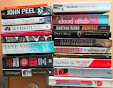
This book elicited one of the widest range of views and scores of any we have read. And this, despite escaping to the less than atmospheric upper room of The Ram due to a Liverpool - Man City football match being shown in the pub below.
In attendance: Chris B (book chooser), Andrew, Chris W, Mark T, Mark W., John Apologies: Willm, Richard and Steve
CB found it a very readable book and an engaging story. A satisfying book that hangs together as a convincing story despite the sci-fi context. SC really liked the book. It almost always passed the ‘do I want to pick it up and read it tonight’ test. It feels like an original, ambitious and absorbing creation. Overall, a big, interesting and readable book with thought-provoking ideas and some entertainingly sexy bits. A bit long but he liked it.
RV though unfinished, was enjoying the book. It is very well written, with a very interesting protagonist, and is a book which raises a host of interesting ideas and issues, interleaved with a good sense of humour, good characters, interesting premise, and some good dialogue. MW found it easy to read, enjoyable, interesting. CW was happy to pick book up: it had enough new ideas and took different directions. MT was devouring it!
AA thought it terrific, beautifully written and Conradesque; a story of love and belonging, faith and fidelity; humanity and inhumanity, elevation and destruction, responsibility and deceit; individual and groups; fragility of everything; collapse of our planet as expected; suspense eg at the airport and carried on to the end. It progressed slowly; but he was keen to read on.
But JH found it a chore, an interesting idea made dreary. And for Willm, this wasn’t about strange new things but a rehash of tired old things. He found the language and structure exceedingly simplistic, which had the virtue, probably unintended, of making it a very rapid read.
CB liked the imagination and level of detail in the journey and on Oasis. It made a rich context for the story. Plenty of drama with the Jump (the way the spacecraft gets to the planet), the risks Peter, the protagonist faces on the strange planet and the guarded and somewhat one dimensional relationships on the base. Nice touches: layers of detail: language, form, houses, sleeping etc of the Oasans; gradual engagement with Grainger, chapter headings as the last phrase in the chapter; plants, animals and landscape on the planet; rain and atmosphere; humour of misunderstandings e.g. passing water.
MW thought the Sci Fi ideas showed good imagination; but it was not such a big idea as Faber’s Under The Skin. CW thought some elements such as the building of the church and living with Oasans lacked interest: the Oasans were already converted. But he liked the imagery of the planet and the Brassiere and the mix of settings and detail eg cars. It raised questions: Why did the Oasans make crops in exchange for the drugs? Can you really screen out human characteristics so people can live in a sterile environment. But made you think. SC too liked the sci-fi flavour - in a way this helps to unshackle the narrative from everyday distractions of earth-bound living, gives the author a chance to really fly with his ideas
For JH, the highpoint was Tesco going bankrupt. What was this book? Space exploration, colonisation, collapsing love story, faith collapsing? Interesting about how an ex-pat works in relation to people at home. But we should focus on solving our planet’s issues not spending money on space exploration.
MT found the religion interesting: related to his experience in a religious family.
AA thought it disappointing that Oasans spoke English and have a quasi human form. But liked the idea of faith as Peter’s latest addiction; the Eulogy for Severin; the proposal to Bea; the birth and death amongst the Oasans, the rain, alternation of earth and planet; the difficulty of communication when the “shoot” is less personal; humans being dependent on vulnerable people. Backstory was clear and consistent. Interesting: USIC staff keeping separate from their past; Tartaglione’s rant was good. Faber rejected his parents beliefs. Is this book about religion or human beings?
RV highlighted a passage from the very start (page 3) which shows both ideas and humour.
“Of course, everybody on earth had the power to reshape reality. It was one of the things Peter and Beatrice talked about a lot. The challenge of getting people to grasp that life was only as grim and confining as you perceived it to be. The challenge of getting people to see that the immutable facts of existence were not so immutable after all. The challenge of finding a simpler word for ‘immutable’ than ‘immutable’.”
He was struck by at least 50 different paragraphs or sentences, for example, when Peter looks through the Visitor’s Book in the Heathrow Prayer Room; his rather amazing sermon for Severin’s funeral; his interesting discussion of translations (“once it dawned on you that everyone who wasn’t a native speaker of Canaanite Hebrew, Koine Greek or Galilean Aramaic was at an equal disadvantage, you could relax and feel that Scripture in your own tongue was as good as Scripture in anyone else’s”); his lovely use of arcane English: “frankly barmy / he pointed out, with stonkingly obvious good sense”.
RV found Peter’s voice very authentic, and extremely different to the protagonist in Under the Skin – he clearly can write in very different ways. In some ways the book reminded RV of a science fiction novella he read 40+ years ago – A Case of Conscience, James Blish - https://en.wikipedia.org/wiki/A_Case_of_Conscience (a book that was very powerful at the time and one that has clearly stayed with him) also about a missionary to an alien race.
The book is by no means perfect (why does Peter not ask more questions of the Oasans, and the M6 does not go south of Birmingham!). But it captures someone’s clear faith very well, and his ability to describe and discuss faith is extremely good.
For WM, the social references at the Base were all curiously anachronistic: posters depicting Rosie the Riveter, and the men eating lunch on a skyscraper girder; the music of Bing Crosby, Judy Garland, Frank Sinatra; and odd turns-of-phrase. All this from before the author was born and as the novel was set in the future, even if ever-so-slightly, most peculiar. And, why on earth (literally) would they choose Peter of all available Christians? Why is everyone at Base (apart Grainger) so unbelievably passive? Why do two people go awol? Something in the white flower foodstuffs?
Many quotations from the Bible, as might be expected, but is this really the way evangelical spouses communicate with each other? And, do they feel the need to explain the ‘real’ meaning of the citations? E.g. ‘Philippians 4:6 reassures us “be careful for nothing (i.e. don’t be anxious about anything)” ‘. On page 162 our hero writes to his wife that John said “Love not the world nor the things of the world. For all that is in the world, the lust of the flesh, and the lust of the eyes, and the pride of life, is not of the Father, etc.etc.” Although she is the one who converted him, and probably just as familiar with this quote as he is, he then goes on to ‘mansplain’ that John was being too harsh and that Jesus understood, and God understands, that people have a whole life to live before they die. ‘Mansplaining’ apart, I would have that thought that being cognisant of what Jesus understood and God understands is quite possibly a little above his pay grade.
Now, the author may just have been illustrating that this type of evangelical fervour is somewhat self-absorbed, or self-referential, and that Peter was hiding any real understanding, feelings or empathy behind a cloak of quotations. However, it seems to me that the author is fundamentally in sympathy with our Father Peter and that the whole ‘novel’ is really Saint Michel’s epistle to the converted, to the ignorant, and to naive 13 year olds who are seeking the ‘meaning of life’ and the answers that religion might provide. The medium is the message.
SC agreed. He could have done without the detailed discussion of specific Bible passages, particularly as ‘translated’ by Peter. Was the author preaching, maybe trying to show off the depth of his Bible studies knowledge, or simply trowelling it on more thickly than the narrative really required? SC’s money’s on the latter. What was the author really trying to do here- was he coming up with a strong critique of Christian theology (which would have been ambitious), or making a more focused and barbed point about the innate flimsiness of any belief structure based on a single book, no matter how well it’s been parroted?
SC thought perhaps it’s a great love story. From quite early on, he was hoping Grainger and Peter would get it on. The finale, which is not necessarily as expected, is sad and reminds him a bit of A Clockwork Orange, where Alex becomes a tool of the establishment.
SC thought the book is not without problems. The idea that Peter, a former criminal drug addict, has been selected to come and minister to an alien race which has ‘discovered’ God through a predecessor, purely to ‘keep them sweet’ and continue the trade in whiteflower products, is tenuous to say the least. Any such discovery of alien life would have triggered the most intricately analytical and complex project to learn as much as possible about these beings. Instead they are regarded as freaks and a hindrance to the aims of the colony. Really difficult to relate to this particular angle.
However, if somehow one lets that go, the idea of a drug-addict religious zealot (and his hornily zealous wife) arriving to build a church and adopt the missionary position somehow fits the plot, as does his gradual progress to ‘going native’ - a touch of Heart of Darkness here? SC liked the descriptions of the alien world and its inhabitants, though felt that it was rather lacking in detail, perhaps deliberately so.
CB liked the way Peter as a human being comes through the beliefs, whether his sexual urges, his doubts, his difficulty in communicating with his wife, his enjoyment of the calmness of the Oasan community, his despair at the sterile life of the base. In the end, his human experience overtakes his faith. CB really liked the description of faith: a strong belief but could equally be a human construct plus confusion of when God is responding or whether it is just a human reaction (eg when he wants to talk to his wife in the car on his first journey to the Oasans.
CB liked the development of the effect of being apart in a relationship and having very different experiences is well developed over time with a backdrop of disasters back on earth contrasting with Peter’s positive experience of his ministry and mainly calm life amongst the Oasans. By contrast, the community of people at the base are happy to leave their old lives behind and are self sufficient and work focussed which makes the times when people break out of this more full of tension and pathos (Grainger, Tartaglione, Kurtzberg).
SC agreed Bea’s bulletins from home kept ringing uncannily true, and all the more unsettling for that. Her growing anger with him and his lack of empathy with real world problems was believable, as was her increasingly dicey predicament. MW thought the relationship with three “women” the most interesting including deteriorating relationship with his wife, development of relationship with Grainger; weak character, end not satisfactory, lacked something.
For MT, the letters felt real and like his own experience, including the drifting apart. The Grainger relationship was interesting; the tension was good as they didn’t develop the relationship; felt the ending was left unresolved but liked the tension of this. AA asked has the relationship ended because it was based on faith which is lost? He liked the summing up of Peter’s dependency as being more on a woman than on Jesus.
For CB, the context at home feels like a very real threat as society slowly then more quickly starts to break down. And serves to alienate the couple further. Bea’s reactions are well developed even via the medium of letters. And the asserted purpose of the base as a base for the rich to escape to eventually comes out along with the reasons Peter is asked to minister to the Oasans.
So we found lots to like and be interested in as well as things to really dislike. An average score of 6.82 with a range of 2 - 8.5.
Scores: John 3.5; Mark T 8.5; Andrew 8.5; Chris 7.4; Mark W 7.2; Chris 7.75; Willlm 2; Steve: 8.5
Richard: 8
Showing posts with label religion. Show all posts
Showing posts with label religion. Show all posts
Monday, 14 January 2019

Sunday, 4 March 2018
The Three Daughters of Eve by Elif Sharak
We thought this was a good book, with an average score of just over 7/10 but will lots of reservations.
It’s an interesting story of the contrast between West and East, specifically UK and Turkey, London and Istanbul. And the contradictions in the Turkish middle class - wanting the life of a well off Westerner and yet mistrusting and ridiculing thy west too. Chris liked the discussion of politics and description of contrast between public utterance and private anger. It felt real. Others did not like this extended dinner party narrative. It was more Riviera than McMafia, said Neil. Richard loved Sherwin’s cliché about Turkey: “‘What I’m saying is they either have a sunny impression – sandy beaches and Eastern hospitality, that kind of shit. Or a gloomy one – Islamic fundamentalists, police brutality and Midnight Express. When they want to be nice to you, they throw in the first; when they want to challenge you, it’s the second. Even the most educated are not immune to clichés.’”
The book throws lots of issues into the air e.g. sexism, religion vs secular – but does not quite land them all. Chris liked the range of the issues that were explored, politics, religion, east west relationship, sexual politics, childhood, trans-cultural relationships, childhood, and marriage. The book raises and attempts to deal with a range of issues which have great resonance for today’s world. She writes “Peri – and hundreds of youngsters like Peri – would become an educated, idealistic, forward-thinking graduate who would rescue this country from its backwardness” which of course gets juxtaposed with what is happening now in Turkey (with the raid on the house, the guns, the attempted rape in the streets all able to be seen as a riff on the state of the country today, where this ‘educated, idealistic, forward-thinking graduate’ group are now cowering indoors hoping not to get arrested, tortured or shot).
The most interesting passages for Richard were related to both religion and culture: “Was religion an empowering force for women who otherwise had limited power in a society designed for and by men, or was it yet another tool for facilitating their submission?” I very much liked the fact that there were women in the book who represented all viewpoints, and that the book raised (but did not really force an answer to) so many of these key questions – ones that I have grappled with myself over the years. I used to feel that religion was something that society had outgrown – it was needed in the past to hold society together and to ensure that basic rules of social groupings were followed; but that we had evolved as a group of societies to the extent that there was sufficient shared belief in the importance of these rules that we no longer needed the ‘do it because God commands it’ rationale – we could do it because we collectively agreed that these rules led to a better and more equal and fairer society. Now, I am far less sure – I feel that the loss of ‘religiosity’ in a lot of the West has coincided with a negative shift within society towards inequality and unfairness, and a rise in substance misuse and anti-social behaviour, and that maybe turning away from religion has not been good after all. I am not sure, and neither is the book, and I liked it the more for that.
Richard: There were also resonances for me about my own relationship with Judaism – as with Peri: “Culturally she was a Muslim, no doubt. Yet the number of prayers she had learned by heart would not exceed the fingers of her hand. She neither practised her religion nor acknowledged, as Shirin did, being a lapsed Muslim.” And yet, there are cultural bonds which mean that wherever I am in the world, I know that I could find a Jewish community who would immediately take me in: “Invisible strands of solidarity threaded among strangers who, upon finding out they shared the same religion or nationality, developed an instant affinity. A camaraderie that manifested itself in the smallest details – a smile, a nod, a sandwich.”
As is often the case (it was towards the end of the last book, on slavery in the US) there is one passage that contains the heart of the book. Here, for me, it was this: “‘You say our life is only one of many possible lives we could have led. And deep inside I think we all know this. Even in happy marriages and successful careers there’s an element of doubt. We can’t help wondering what our lives could have been like had we chosen another path … or paths, always plural! And you tell us that our idea of God is only one of many. So what is the point of being dogmatic about God – whether we are theists or atheists?’ ‘That’s right,’ Azur said, his gaze sweeping across her face, surprised and pleased to hear such an outburst from her. ‘But you have to know there are many in this world, like my mother,’ Peri continued, ‘whose sense of security comes from their faith. They’re convinced that there is only one interpretation of God: their own. These people already have enough to deal with, and you want to take away their only protection: their certainty. My mother … I mean sometimes I look at her and I see so much sorrow, I can sense she would’ve gone crazy without her faith to hold on to.’ Silence opened up between them as delicately as a silk fan. ‘I understand. But absolutism of all kinds is a weakness,’ Azur said. Absolute atheism or absolute theism. To my mind, Peri, they are equally problematic. My task is to inject the faithless with a dose of faith and the believers with a dose of scepticism.’”
Some felt it was almost chick lit with some Mills and Boon style writing. Whilst admiring the learning and intelligence of approach of the writer, it didn't quite work, was over structured, too long, formulaic and over elaborated.
Richard liked a lot of the language (an example is “Time, like a skilful tailor, had seamlessly stitched together the two fabrics that sheathed Peri’s life: what people thought of her and what she thought of herself” or “a mixture of scents – fried aubergine, ground coffee, freshly baked flatbread, simmering garlic – emanated from the open windows, so strong that it permeated everything, seeping into gutter drains and manhole covers; so sharp that the morning wind immediately changed its direction. But the locals did not complain.”) and a lot of the phrasings (“But solitude was a rare privilege in Istanbul. There was always some important event to attend or an urgent social responsibility to fulfil as if the culture, like a child scared of loneliness, made sure everyone was at all times in the company of others”) both of which captured a feel of the place and the people. There are many other examples of lovely phrasings: “Theirs was a two-storey house, the colour of sour cherries”; “They were as incompatible as tavern and mosque”; “She often wondered what it was that made her father so sad. She imagined sorrow sticking to him like a fine layer of black tar under the sole of his shoe”. But then sometimes she gets it wrong – hence after the lovely bit quoted above about ‘scents’ she ends it with: “But the locals did not complain. They never noticed the smell.” – but these scents (fried aubergine, ground coffee, freshly baked flatbread, simmering garlic) are not ‘a smell’!
Another interesting stylistic point for Richard was that he felt that her writing set in Oxford was led confident, less assured, and felt as if she was less familiar with what she was writing about than the pieces set in Turkey. And Peri taking up running seemed rather easier than it would have been for someone who had rarely done any exercise before – she seemed suddenly to get some shoes (“The same day, she bought herself a pair of trainers”) and that was it! “After a few trial-and-errors she found her ideal route. … Getting into a rhythm was the hardest part, but once she did she could keep on going for almost an hour”. As someone who took up running only this summer, it takes a while to get up to running for an hour! It doesn’t happen almost immediately after buying some shoes! Another amateur-ish phrase was “The next morning they all returned to Oxford. Whenever Mona and Peri talked about their trip to Wales, it would be with a buoyant smile – even though each had sensed, in her own way, that beneath the special moments lay something darker.”
Similarly, her academic work was rather too easy too – “She had no trouble following the lectures.” Well, actually almost everyone studying PPE at Oxford has some trouble following the lectures! I know she is meant to be bright – but that is what happens to bright people when they go to somewhere like Oxford/Harvard/Cambridge/etc – they get confronted by being with everyone who is the brightest in their school/town/community, and that is always challenging to them.
There were also the usual irritating errors – bad copyediting! So we hear that the seminars at on Thursday afternoons (“If you are still interested in my seminar, it begins next Thursday at 2 p.m. sharp!”) and then the next seminar starts with “‘How’s everyone this morning?’”!! And everyone at her Oxford seems to call their tutor ‘Sir’!!! Well, even in the 1970s that didn’t happen – and certainly not in the early 2000s. People are usually called by their first names, or maybe a Dr X or Prof Y, but I have NEVER heard someone called ‘Sir’ at a UK University.
And she introduces unnecessary secrets! “It would take Peri years to discover what he meant by that.” But why – it added nothing to the book – why do so many authors feel that they have to introduce secrets into families – families are complex enough without needing to make them even more complicated!
We liked Peri, the leading character, the unsure, doubtful character contrast with the believer and the atheist. She is a full and credible character with a wide range of emotions and interpersonal relationships. And she has a strong will of her own despite her caution. So whilst trying to straddle the divide between her parents, can also challenge both of them, especially as she grows up. The same happens with her friends. An issue- how did Peri know her English so well? Richard found Peri’s character somewhat irritating at times due to her intense passivity (and found the person that she was at the dinner party and in the street a very different one from the person described at Oxford – and would have liked to know more about how that transition happened). Richard also warmed to her and to the other characters, and found myself looking forward to picking up the book and continuing to read it.
We were less convinced by the characters of Peri’s parents and student friends. Neil felt Troy, for example, was a cartoon character. He also felt Sharak had set up our expectations of the Professor Azur as a brilliant man. But dialogue in the tutorial at Oxford did not work for Neil. The crush on Azur worked well and the conversations about God were well described but then not explored very deeply.
Richard adds: my main problem was with Azur – he is meant to be this amazingly charismatic figure, and yet for me, she has not written him nearly strongly enough. She WRITES that he is interesting, but what he says and does are not that amazingly interesting. She writes at one stage: “But then, as infatuated as she was with him, she abhorred his air of superiority, his bloated pride, the hubris that infused his whole being. He dismissed the worries of others, indoctrinating students with his own perspective, exercising a form of power over them….” But I didn’t really get any of this.
The well signposted scandal was in the end unclear. Why exactly was Azur disciplined and why had Peri "betrayed" him? Richard again: And the BIG THING in the book – her rejection of him, is simply inexplicable to me: “She, Peri, Nazperi, Rosa, Mouse, would not testify. Neither now, nor later. She was not an actor but a mere spectator. This was their problem. Their stupid game. She turned back and walked away as though it were a stranger’s good name at stake and not the future of the man she had loved, dreamed of and desired with all her being. Years had to pass before she came to the realization that her passivity actively contributed to the ruination of the man she loved. When she betrayed Azur, she betrayed the truth.” Inexplicable, unforgivable, and I have no idea why she did that – as she felt a bit shy?! The book did not explain to me at all why she did that.
The settings of Oxford and Istanbul were well described but there was some clumsy plotting and the twin brother came out late in the book. Some bits worked very well e.g. the wedding and its immediate consequences.
Most liked the ambiguity of the emending but were less convinced by the event itself. Ending fine-but not the event itself. The book ends rather suddenly for Chris. what is the point of all her journeying if she now goes out and gets killed? The new beginning after the shift in her relationship with Azur could be very short-lived!
Most enjoyed reading the book. The oscillation between time periods worked well and was helpfully signposted. The story of Peri’s experiences in Oxford and Istanbul was well developed, though the contrast between young Peri and Peri in her 30s is almost too great. It was good to read a "proper novel" with satisfying use of language, range of character and plot. But somehow not all the strands come together to make a really powerful book.
Chris B
Chris B
Mark W 7. 5
Steve 6. 5
Neil 6.7
Mark T 7.6.
Chris 7.5
Chris W 7.6
Richard 6. 5
Steve 6. 5
Neil 6.7
Mark T 7.6.
Chris 7.5
Chris W 7.6
Richard 6. 5
Subscribe to:
Posts (Atom)