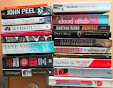
Sunday, 4 March 2018

The Three Daughters of Eve by Elif Sharak


We thought this was a good book, with an average score of just over 7/10 but will lots of reservations.

It’s an interesting story of the contrast between West and East, specifically UK and Turkey, London and Istanbul. And the contradictions in the Turkish middle class - wanting the life of a well off Westerner and yet mistrusting and ridiculing thy west too. Chris liked the discussion of politics and description of contrast between public utterance and private anger. It felt real. Others did not like this extended dinner party narrative. It was more Riviera than McMafia, said Neil. Richard loved Sherwin’s cliché about Turkey: “‘What I’m saying is they either have a sunny impression – sandy beaches and Eastern hospitality, that kind of shit. Or a gloomy one – Islamic fundamentalists, police brutality and Midnight Express. When they want to be nice to you, they throw in the first; when they want to challenge you, it’s the second. Even the most educated are not immune to clichés.’”

The book throws lots of issues into the air e.g. sexism, religion vs secular – but does not quite land them all. Chris liked the range of the issues that were explored, politics, religion, east west relationship, sexual politics, childhood, trans-cultural relationships, childhood, and marriage. The book raises and attempts to deal with a range of issues which have great resonance for today’s world.  She writes “Peri – and hundreds of youngsters like Peri – would become an educated, idealistic, forward-thinking graduate who would rescue this country from its backwardness” which of course gets juxtaposed with what is happening now in Turkey (with the raid on the house, the guns, the attempted rape in the streets all able to be seen as a riff on the state of the country today, where this ‘educated, idealistic, forward-thinking graduate’ group are now cowering indoors hoping not to get arrested, tortured or shot).

The most interesting passages for Richard were related to both religion and culture:  “Was religion an empowering force for women who otherwise had limited power in a society designed for and by men, or was it yet another tool for facilitating their submission?” I very much liked the fact that there were women in the book who represented all viewpoints, and that the book raised (but did not really force an answer to) so many of these key questions – ones that I have grappled with myself over the years.  I used to feel that religion was something that society had outgrown – it was needed in the past to hold society together and to ensure that basic rules of social groupings were followed; but that we had evolved as a group of societies to the extent that there was sufficient shared belief in the importance of these rules that we no longer needed the ‘do it because God commands it’ rationale – we could do it because we collectively agreed that these rules led to a better and more equal and fairer society.   Now, I am far less sure – I feel that the loss of ‘religiosity’ in a lot of the West has coincided with a negative shift within society towards inequality and unfairness, and a rise in substance misuse and anti-social behaviour, and that maybe turning away from religion has not been good after all.  I am not sure, and neither is the book, and I liked it the more for that.

Richard: There were also resonances for me about my own relationship with Judaism – as with Peri: “Culturally she was a Muslim, no doubt. Yet the number of prayers she had learned by heart would not exceed the fingers of her hand. She neither practised her religion nor acknowledged, as Shirin did, being a lapsed Muslim.” And yet, there are cultural bonds which mean that wherever I am in the world, I know that I could find a Jewish community who would immediately take me in: “Invisible strands of solidarity threaded among strangers who, upon finding out they shared the same religion or nationality, developed an instant affinity. A camaraderie that manifested itself in the smallest details – a smile, a nod, a sandwich.”

As is often the case (it was towards the end of the last book, on slavery in the US) there is one passage that contains the heart of the book. Here, for me, it was this:  “‘You say our life is only one of many possible lives we could have led. And deep inside I think we all know this. Even in happy marriages and successful careers there’s an element of doubt. We can’t help wondering what our lives could have been like had we chosen another path … or paths, always plural! And you tell us that our idea of God is only one of many. So what is the point of being dogmatic about God – whether we are theists or atheists?’ ‘That’s right,’ Azur said, his gaze sweeping across her face, surprised and pleased to hear such an outburst from her. ‘But you have to know there are many in this world, like my mother,’ Peri continued, ‘whose sense of security comes from their faith. They’re convinced that there is only one interpretation of God: their own. These people already have enough to deal with, and you want to take away their only protection: their certainty. My mother … I mean sometimes I look at her and I see so much sorrow, I can sense she would’ve gone crazy without her faith to hold on to.’ Silence opened up between them as delicately as a silk fan. ‘I understand. But absolutism of all kinds is a weakness,’ Azur said. Absolute atheism or absolute theism. To my mind, Peri, they are equally problematic. My task is to inject the faithless with a dose of faith and the believers with a dose of scepticism.’”

Some felt it was almost chick lit with some Mills and Boon style writing. Whilst admiring the learning and intelligence of approach of the writer, it didn't quite work, was over structured, too long, formulaic and over elaborated.

Richard liked a lot of the language (an example is “Time, like a skilful tailor, had seamlessly stitched together the two fabrics that sheathed Peri’s life: what people thought of her and what she thought of herself” or “a mixture of scents – fried aubergine, ground coffee, freshly baked flatbread, simmering garlic – emanated from the open windows, so strong that it permeated everything, seeping into gutter drains and manhole covers; so sharp that the morning wind immediately changed its direction. But the locals did not complain.”) and a lot of the phrasings (“But solitude was a rare privilege in Istanbul. There was always some important event to attend or an urgent social responsibility to fulfil as if the culture, like a child scared of loneliness, made sure everyone was at all times in the company of others”) both of which captured a feel of the place and the people. There are many other examples of lovely phrasings: “Theirs was a two-storey house, the colour of sour cherries”; “They were as incompatible as tavern and mosque”; “She often wondered what it was that made her father so sad. She imagined sorrow sticking to him like a fine layer of black tar under the sole of his shoe”.  But then sometimes she gets it wrong – hence after the lovely bit quoted above about ‘scents’ she ends it with: “But the locals did not complain. They never noticed the smell.” – but these scents (fried aubergine, ground coffee, freshly baked flatbread, simmering garlic) are not ‘a smell’!

Another interesting stylistic point for Richard was that he felt that her writing set in Oxford was led confident, less assured, and felt as if she was less familiar with what she was writing about than the pieces set in Turkey. And Peri taking up running seemed rather easier than it would have been for someone who had rarely done any exercise before – she seemed suddenly to get some shoes (“The same day, she bought herself a pair of trainers”) and that was it! “After a few trial-and-errors she found her ideal route. … Getting into a rhythm was the hardest part, but once she did she could keep on going for almost an hour”. As someone who took up running only this summer, it takes a while to get up to running for an hour!  It doesn’t happen almost immediately after buying some shoes! Another amateur-ish phrase was “The next morning they all returned to Oxford. Whenever Mona and Peri talked about their trip to Wales, it would be with a buoyant smile – even though each had sensed, in her own way, that beneath the special moments lay something darker.” 

Similarly, her academic work was rather too easy too – “She had no trouble following the lectures.” Well, actually almost everyone studying PPE at Oxford has some trouble following the lectures! I know she is meant to be bright – but that is what happens to bright people when they go to somewhere like Oxford/Harvard/Cambridge/etc – they get confronted by being with everyone who is the brightest in their school/town/community, and that is always challenging to them.

There were also the usual irritating errors – bad copyediting!  So we hear that the seminars at on Thursday afternoons (“If you are still interested in my seminar, it begins next Thursday at 2 p.m. sharp!”) and then the next seminar starts with “‘How’s everyone this morning?’”!! And everyone at her Oxford seems to call their tutor ‘Sir’!!! Well, even in the 1970s that didn’t happen – and certainly not in the early 2000s.  People are usually called by their first names, or maybe a Dr X or Prof Y, but I have NEVER heard someone called ‘Sir’ at a UK University.

And she introduces unnecessary secrets! “It would take Peri years to discover what he meant by that.” But why – it added nothing to the book – why do so many authors feel that they have to introduce secrets into families – families are complex enough without needing to make them even more complicated!
We liked Peri, the leading character, the unsure, doubtful character contrast with the believer and the atheist. She is a full and credible character with a wide range of emotions and interpersonal relationships. And she has a strong will of her own despite her caution. So whilst trying to straddle the divide between her parents, can also challenge both of them, especially as she grows up. The same happens with her friends. An issue- how did Peri know her English so well? Richard found Peri’s character somewhat irritating at times due to her intense passivity (and found the person that she was at the dinner party and in the street a very different one from the person described at Oxford – and would have liked to know more about how that transition happened). Richard also warmed to her and to the other characters, and found myself looking forward to picking up the book and continuing to read it.

We were less convinced by the characters of Peri’s parents and student friends. Neil felt Troy, for example, was a cartoon character. He also felt Sharak had set up our expectations of the Professor Azur as a brilliant man. But dialogue in the tutorial at Oxford did not work for Neil. The crush on Azur worked well and the conversations about God were well described but then not explored very deeply.
Richard adds: my main problem was with Azur – he is meant to be this amazingly charismatic figure, and yet for me, she has not written him nearly strongly enough.  She WRITES that he is interesting, but what he says and does are not that amazingly interesting. She writes at one stage: “But then, as infatuated as she was with him, she abhorred his air of superiority, his bloated pride, the hubris that infused his whole being. He dismissed the worries of others, indoctrinating students with his own perspective, exercising a form of power over them….” But I didn’t really get any of this.

The well signposted scandal was in the end unclear. Why exactly was Azur disciplined and why had Peri "betrayed" him? Richard again: And the BIG THING in the book – her rejection of him, is simply inexplicable to me: “She, Peri, Nazperi, Rosa, Mouse, would not testify. Neither now, nor later. She was not an actor but a mere spectator. This was their problem. Their stupid game. She turned back and walked away as though it were a stranger’s good name at stake and not the future of the man she had loved, dreamed of and desired with all her being. Years had to pass before she came to the realization that her passivity actively contributed to the ruination of the man she loved. When she betrayed Azur, she betrayed the truth.” Inexplicable, unforgivable, and I have no idea why she did that – as she felt a bit shy?! The book did not explain to me at all why she did that.

The settings of Oxford and Istanbul were well described but there was some clumsy plotting and the twin brother came out late in the book. Some bits worked very well e.g. the wedding and its immediate consequences.

Most liked the ambiguity of the emending but were less convinced by the event itself. Ending fine-but not the event itself. The book ends rather suddenly for Chris. what is the point of all her journeying if she now goes out and gets killed? The new beginning after the shift in her relationship with Azur could be very short-lived!

Most enjoyed reading the book. The oscillation between time periods worked well and was helpfully signposted. The story of Peri’s experiences in Oxford and Istanbul was well developed, though the contrast between young Peri and Peri in her 30s is almost too great. It was good to read a "proper novel" with satisfying use of language, range of character and plot. But somehow not all the strands come together to make a really powerful book.

Chris B

Mark W 7. 5
Steve 6. 5
Neil 6.7
Mark T 7.6.
Chris 7.5
Chris W 7.6
Richard 6. 5


Thursday, 4 January 2018

The Sellout by Paul Beatty

Neil opened by explaining that his choice had been driven by an interest in reading the Booker prize winner most years, by his daughter’s recommendation, it having been one of the few books she has read recently, and the intriguing write-up that clearly suggested this was something a little out of the ordinary.  Overall Neil found it challenging but interesting and felt that the author rather let himself down with a terrible Prologue that really wasn’t the best possible introduction to the book despite the superb opening lines and the occasionally clever idea such as the idea of setting up a Tattoo service specialising in Latin text.  Indeed this often seemed to be the case that there were brilliant comic ideas in the novel, but that sometimes they didn’t always hang together neatly in a typical novel narrative.  Nevertheless, once the main story started, Neil found this quite entertaining.

Some of Neil’s favourite bits of humour included the way Me got Hominy’s slave beatings contracted out to a BDSM prostitute, the bull castration at the school job demonstration day and the day in the park when all the gangs got on because they were so stoned on his special marijuana and enjoying his watermelon too much.   At the same time, behind the humour the author had, in Neil’s opinion, managed to communicate some very important themes and messages, including the complete failure of de-segregation for many schools in America and the fact that racial segregation as a whole seems to be something that has happened anyway in America and will continue to without positive action taken to generate true equality.  These factors compensated Neil for the sometimes difficult language, absurdist storytelling and the heavily US context that sometimes required further investigation in order to understand their validity, such as the existence of the real Our Gang/Little Rascal  films which had indeed been a source of racial controversy for many years.

Chris W had also found the first 30 or 40 pages rather nonsensical, but admitted that once the main story started, he really enjoyed it. Although he felt that perhaps it was less a story as a theme and series of ideas. Chris was surprised to find that he found the book more interesting in many ways than something like Sunset Song because it was so contemporary and relevant.  He was one of two or three of us who had just been watching Miriam Margolyes’ new series on TV following her travels through the US and encountering people and places who might have come straight out of the book.  It certainly stirred up lots of reflective thoughts for Chris about the US and its issues.

Mark W had just finished the book and started by making it clear that he is no fan of the US in general as a country, race or culture which was therefore perhaps not the best starting point from which to be approaching the book.  He also found that reading it over the Christmas break maybe contributed to him finding it a hard, if worthy, book.   Mark is not bothered about the Booker prize, didn’t enjoy the narrative and didn’t identify with the characters.  He was perhaps most irritated by the stereotypical portrayal of black culture and doesn’t like the way the English language is subverted with all the swearing in the dialogue.  He found one redeeming feature in a little bit of irony at the end of the book as he feels this is something Americans don’t generally do.

Chris B found this harder to read than the Scottish book, of which he has just finished the complete trilogy.  He too was irritated by it.  There were too many references for him to localised things that he knew nothing about and couldn’t relate to.  He hadn’t finished the book (due to the Scottish trilogy being so enthralling) and was only just beginning to appreciate some of The Sellout as he got further into it.  He agreed with the “worthy” tag and acknowledged that there were some good pieces of writing when taken in isolation.

Steve thought this was an American book meant for Americans and wondered if authors ever thought about who would end up reading their work and modifying it accordingly.  Anyway, Steve found this rather alienating and the book as a whole somewhat “relentless”. He pointed out that sometimes sentences were more than half a page long and contained so many things that you could easily skip parts and not miss anything.  He did quite like the central character and his self-deprecation, such as the admission that he was “a shockingly poor lover”.  He admitted that the book was at times clever and thought-provoking, but he found it hard to have any affinity with.

Mark T found this easier to read that Sunset Song with its archaic Scottish and he too liked the main character.  He also hadn’t finished the book yet but was finding it quite accessible whilst not necessarily enjoying it. He liked some of the comic ideas, such as Foy re-writing Mark Twain to be less racist.  However, overall he thought it intriguing but hard-going in what he had read so far.


Richard emailed in to say that he had found the book distinctly underwhelming and that while the author was clearly knowledgeable and erudite, to him it felt as if he were listening to a very long rap song…not itself necessarily an issue, but a book-long rap song is too long for anyone.  He found the book to add up to less than the sum of its parts, even though some of the writing was quite lyrical. It took Richard ages to get into the book, let alone understand what it was all about.  He definitely didn’t find it laugh out loud funny, nor hilarious or profound.  A clever author perhaps who has written a no-doubt clever book, but Richard can read clever for work, he’d rather not for pleasure.

Thursday, 7 December 2017

Sunset Song by Lewis Grassic Gibbon


Notes on Sunset Song  by Lewis Grassic Gibbon

BBBC Meeting on Thursday 7th of December 2017 at the Hop Pole in the Upper Bristol Rd.

Almost a full house, Richard being the only absentee but he had sent his notes prior to the meeting which we tried to ignore so as to avoid undue influence.

This book was chosen by Mark W on the back of a film which he had enjoyed and therefore investigated the book upon which it was based, finding the following quote on the Polygon edition: ‘Voted the ‘Best Scottish Book of All Time’. Interestingly two of the Group watched the film for differing reasons, one because he liked the book and the other because he didn’t, but both didn’t enjoy the film, again for different reasons. We will come back to the film later.

This was one of those books which produced very different responses which seemed to depend on whether one was prepared to persevere with the opening 100 pages or so. It is worth saying at the outset that one of the key characteristics of this book is that it is written with a number of words which are probably best described as ‘local vernacular’ which at best took some getting used to and at worst were so off putting that it made the book ‘a bit of a slog’ for some and ‘unreadable’ for others.

So there were essentially two camps: those who decided to persevere and those who didn’t. The fact that some versions of the text included maps, notes and a glossary was a surprise to some and some commented that this might have made a bit of a difference.

In introducing the book Mark W made comparisons with ‘A Month in the Country’, the previous month’s book and Thomas Hardy, particularly ‘Far from the Madding Crowd’.  In addition to the use of local dialect, themes picked up in the Group discussion and by Richard in his notes were :

·         The demise of a rural way of life and gradual modernisation of farming and rural life as a whole although there were no rose tinted spectacles here and the poverty and hard work was presented without any affection. This in contrast to ‘A Month in the Country’ which was a more affectionate look back at the same period.

·         The strong female protagonist and her journey from growing up within a highly patriarchal society with a dominating abusive father to a becoming a married woman and subsequently a widow. The role of women and how difficult and unfair life was for so many of them.

·         The First World War and its devastating effect on society which challenged the whole class system, magnified by some of the events occurring abroad, notably in Russia.


Mark referred to three particular scenes in the book that he felt were particularly memorable for him. Firstly the point following the funeral when Chris shed tears for her father after having been pretty cool and matter of fact about the whole thing. Secondly Ewan’s sudden change of character after having spent some time training before being sent to the front (which incidentally was a bone of contention at the time of writing and Gibbon defended himself saying that it was based on personal experience). Thirdly the final scene up on the moors with the memorial and the piper playing Flower of the Forest.


Firstly turning to the language issue Chris B probably summed up the feelings of most, finding the book ‘….intensely annoying and feeling pretty frustrated at the beginning, with the mixture of languages making it hard to understand’ . Two of the Group, Mark T and Chris W didn’t get past the sense of irritation, Mark T ‘didn’t like it at all, felt irritated, and couldn’t get into the story, and gave up after about 100 pages’. Similarly Chris W also got to about the same point of the book and then decided ‘not to force myself to finish’ and ‘then decided to watch the film with his family who all got bored!

The rest of the Group decided to ‘go with the flow’ and most found that a) the book got easier to read once they had learnt a dozen or so frequently used words, e.g. meikle =large and quean =girl, and b) that the book was actually rather enjoyable.

Chis B surprised us by initially saying that he was about 70% through, then adding that he was 70% through the trilogy! His moment of change was when the book started to focus on Chris who he found to be a ‘great character, reflective and forceful, and very well placed in the environment’. He particularly enjoyed the subtle observations of village life, the gossips, their enjoyment of being shocked by scandalous events, the metaphor of the war which had a devastating effect on Ewan and subsequently Chris. He particularly loved her reflections on life and her relationship with the natural world. He also enjoyed the political observations and the caricatures of the English.

Steve observed that only when he got to the end did he discover the map which might have helped him had he discovered it sooner. Steve was particularly reminded of ‘The Archers’ but nevertheless enjoyed the book, after having found it difficult to get going like most. He got to a point where he stopped looking words up and was also able to ‘go with the flow’.  He observed that there had obviously been a lot of analysis and study of the book. He did get interested in the plot but there were no real surprises. He found Chris to be ‘a fantastic character, but also very funny, with a sly sense of humour’. He also observed that he felt that he wasn’t really the target audience for the book, and felt a bit excluded.

Neil generally found the language ok although it was a bit hard as first. He felt relieved when the father died. He found it interesting that a male author could come up with such a strong female character and he found that the book ‘painted a vivid picture of the farm and the land with great characters’. He observed that the Great War came along and turned the people against each other, with particular intolerance against those who disagreed with the War and didn’t want to fight. There was a lot of drama and it was vividly portrayed. He did add that he, like Chris B, may well be inspired to read the trilogy. He also added that he was tempted into watching the film which he didn’t enjoy at all.

Finally, Richard’s written notes indicated general agreement with most of those who had ‘gone with the flow’, finding the book ‘interesting and quite enjoyable’. He found that ‘there was a lot of quite lovely language’ and ‘a number of interesting themes’ but ‘overall it won’t go down as one of the highlight books of the year’.

Scores as follows: Mark W 8.0, Chris B 7.5, Mark T 3.0, Steve 7.0, Neil 7.5, Chris W 5.0 and Richard 6.0. So quite a mixture (which is always tends to result in a lively discussion!)

Mark W December 2017

Monday, 6 November 2017

A Month in the Country - J.L. Carr

BBBC Meeting:  Thursday, 2nd November 2017, Flower and Forrester, Combe Down
Present: Richard, Steve, Neil, ChrisW, MarkT, MarkW, and new (potential) member, John Hailey.  Apols received alongside notes: ChrisB

Carr, J.L.. A Month in the Country (Penguin Modern Classics)
This was a book which was enjoyed a lot, by everyone in the group.  “What a lovely book”, “a lovely small book”, “an absolute masterclass of how to use such a few words to cover so much”, “I really enjoyed it”. “absorbed”.

The enjoyment was for many reasons.

One was the author’s style: “he writes beautifully, with no excess of fat”. Many remarked on the fact that the book was so short – not much longer than some short stories – yet so much was conveyed.  Carr gave wonderful descriptions – of buildings, countryside, people, machinery. He used lovely language. His writing had humour (“‘Now,’ he said, ‘… to touch on a delicate topic.’ It apparently was going to be very delicate, because he lowered his voice”), occasional darkness of tone, but elegiac, creating a seamless line to a now-long-distant world.

Another was his ability to evoke the time and the place – many of us felt that we could actually see Oxgodby; experience the idyllic summer, the English countryside, a reminder of the era of hay fields, the community camaraderie: all things now lost, our lives are too fast. There was also the lost idea that people did not travel far from their birthplaces – many had never met someone from London, most had no concept of ‘taking a holiday’.

Yet another was his development of character – mainly Birkin of course (“‘But you would have listened. You do listen. And you know how to be still. Don’t you know that, when people are with you, they don’t feel they have to say something? I mean just say anything to fill in silences. Were you always good at listening? When you were a little boy?’”), but the other characters are all well-drawn – Alice, Keach, Moon, Kathy Ellerbeck.

Another was his keen insights and sharp observations into people and places: that people always think that they will have more time later to look properly at something, that sometimes people who put on a bold front are actually very shy, and when “caught off-guard, go to pieces”, that when we eat cuisine from a local area, which gets lost in a developing global world, we are “eating disposable archaeology”, that as we age, our memories of who we were and how we thought about things fade and have to get reconstructed – and sometimes we can’t quite believe that the person we re-construct could actually have been us.

Yet another was how short the book was, and yet how satisfying it was – although shorter than some ‘short stories’, it covered his journey, from trauma to (better) psychological health and acceptance. The Month in the Country allowed relationships to develop whilst at the same time creating the circumstances to allow him to heal himself, with the people and relationships around all being part of the healing – and the revealing and healing of the painting is a metaphor for the revealing and healing of Birkin.

We generally enjoyed the relationship between Birkin and Moon, and the developing relationship between Birkin and Alice.  

We enjoyed the presence of ‘the War’ – as an undercurrent, clearly hugely important and damaging, and yet not laboured, not ‘laid on with a trowel’ (although it was also noted that there seemed to be only one death in the town, and that did not accord with all of our experiences of going to almost every town or village in the country and seeing a War memorial with long lists of those who had been killed in the Great War).

Although all did enjoy it, there were some who were not totally convinced by all aspects.  Birkin was only 23, but seemed very much older (but maybe the war aged him faster?) But he didn’t seem especially traumatised – he tells us that he has a facial tick and a stammer, but they seem very external to him – within himself, he seems rather UN-affected. And it seemed unlikely that at 23, he could be able to be one of the major experts in church painting restoration, especially if he had spent some years in the Trenches. Had he gained all of this knowledge and experience in the 18 months since the end of the war and him being demobbed?  And what changed him so that he could simply walk away at the end, and not tell the Times what he had done, when that was such an important pull in the first place? “I was so excited that only darkness stopped me from making a start. What luck! My first job … … And I willed it to be something good, really splendid, truly astonishing. Like Stoke Orchard or Chalgrove. Something to wring a mention from The Times and a detailed account (with pictures) in the Illustrated London News.

There were also many individual takes on this book. 

Richard saw links between this book, about a medieval painter and people in a more modern age using it as a way of linking with that long-dead artist, and another book we have read, which he particularly loved: Ali Smith’s ‘How To Be Both’.

MarkT saw great similarities with aspects of his own upbringing and experiences – a church-going upbringing, lay preaching, making first relationships with other young people within the Church and so on – realising that some pretty religious girls might fall for not so handsome boys!

John saw that the book was actually much darker than others had remarked.  It was an evocation of the ‘last days of the horse’. The fantastic and amazingly talented painter falls and dies whilst paoingitn the picture. Birkin is very damaged by the war (his screams in the night joining with the screams of the dying animals). The young girl dying of consumption. Moon being ‘outed’. The huge cold bare house that Keach and Alice rattled around in. There were many dark sides and dark vignettes running throughout the book: rural bliss, but with many elekents of darkness (which was probably true to life, too).  

The fact that the book was enjoyed by all was reflected in the scores given, other than Chris Born’s one – his comments suggested that he also really enjoyed the book, but whereas everyone else’s scores ranged between 7.5 and 9.0 (mean 8.43) he gave it a measly 6.0.

Even with this relatively lowly score by Chris, this becomes the 2nd highest scoring book over the past 12 months and the 3rd highest scoring book since September 2014 (the books scoring even higher were ‘Of Human Bondage’ and ‘Olive Ketteridge’).


Richard Velleman
6th November 2017

Tuesday, 3 October 2017

The Noise of Time, by Julian Barnes


A full house met at the Coeur de Lion in Bath, 7th September 2017.

The group came to this book having surprisingly not read any Julian Barnes as one of our choices, though some did indulge in an off-piste assignment when he came to the Bath Lit Festival a few years ago. We were all to a greater or lesser degree familiar with his work – some more with his earlier books such as Metroland, others with more recent novels.

The response was broadly pretty positive. It’s a book about the Russian composer Shostakovich – a kind of ‘novelistic biography’ as one of us had it. Well-structured, well written and therefore pretty easy to engage with. One or two did find the early sections harder to connect with, and only felt some kind of momentum was achieved later in the book as the narrative gained some kind of life of its own.

With one exception none of us was on more than nodding terms with Shostakovich’s work. Some took the opportunity to investigate and the comment was made that it was interesting that he ranges from pomp and bombast (his 5th Symphony) to much more avant gard stylings in his maligned ‘Lady Macbeth’ opera, and that the latter, while initially wildly popular, became reviled under the influence of the Party (‘Power’), before being restored to grace in his later years.

We found interesting insights into the life of a self-confessedly flawed character: Eager to enjoy the pleasures of the flesh with his early liaisons we see a man increasingly beset by self doubt, torn between achieving the best expression for his artistic output and, basically, toeing the line. His questioning of the nature of courage, of whether man is a coward if he does what he needs to do to save his life, of the concept of engineering of the soul – these uncertainties were pitched against an apparent sureness that he was best off in Russia, that his former friend and ally Stravinsky has more or less’ sold out’ by setting in America and was to be afforded no sympathy, nor extended the hand of friendship later in life. Bridges were burned.

A comparison was drawn with Dostoyevsky. Lest we should give the impression that we all spend our days with our noses in one gigantic Russian novel or other, it should be pointed out that no-one else in the group was in a position to support or indeed contradict this, but it’s recorded for what it is worth – was Barnes deliberately drawing a comparison with Crime and Punishment, which similarly features a protagonist who, over the course of the book, becomes increasingly introspective?

Several of us were most engaged by the overview of life in Soviet Russia that the book afforded. It’s a compelling ‘biography’ – much more worthwhile than the usual rather tedious shopping lists of all kinds of information that no-one really need to know. Here, Barnes weaves the facts into a narrative that, without ever lapsing into ‘Then he did this, then he did that’, succeeds in painting a vivid and fascinating picture of someone that we really didn’t know too much about.

The book wasn’t without its flaws for some but no-one really took against it.

We gave it an average score of 7.5 out of 10. The conversation progressed across and round Soviet Russia, travel in general and heaven knows what else.

Saturday, 19 August 2017

Peculiar Ground Lucy Hughes-Hallett


Quite a challenging book both to read and review given the breadth of subject matter, characters, historical periods and themes that were interwoven into this book. There was a general consensus among the book club (with the exception of one) that this was "a curates egg" of a book - good in parts but not so good in others.
So here goes with a list of those elements that were appreciated by the critical membership.
The authors expertise as a historian was notable interweaving four different periods into the storyline with characters who were  felt to be generally well drawn with the events of the different periods described well. Her way with words and expertise in the use of archaic english which sounded plausibly appropriate to the historical periods was complimented.
Two of the four periods that were written about-1663 and 1961 were found interesting and developed a number of intriguing themes-the sectarian divides in the Civil War, 17th century parkland design and the foresight of wealthy Landowners planting small trees which would become stately avenues in centuries to come, the devastating impact of the plague, the construction of walls both to contain a private estate and contain a political system and the way in which the uber rich spent their money .The characters that were developed during these two periods were enjoyed  particularly Norris, Nell, Cecily and Flora.
 It was recognised that the wall was a metaphor for keeping people both in and out with the wall around the Wychwood estate, between east and west Berlin and containing modern day prisons being three that were introduced in the book.The recent Brexit vote raising the question of access to Britain for foreigners and Donald Trump's 3000 mile long Mexican barrier were discussed and even Hadrian's Wall keeping out the barbarous Scots. (It was noted that the book club  had read too many books recently about the fall of the Berlin Wall following on so soon after The File (A personal history) which caused tedium for some) .
At the start of the book the description of the multiplicity of religions in England was appreciated-papists, pagans, Methodists and the allusions to witchcraft creating the melting pot from which our"Englishness" is derived. The social hierarchy -The wealthy, the poor with artisans in the middle was well described and interesting to observe the similarities between relationships in 1660 and 1960 at Wychwood but by 1980 these divisions were starting to break down.
On the negative side it was felt that the book lacked coherence and although it was possible to empathise with several of the characters an explanation for the ultimate purpose of the book was missing. Was it meant to be "a historical piece, a metaphysical novel with pagan elements, a soap opera or a social comment on the British class system or what? All very confusing. Did the author really know what she was trying to do?" "At this point I wondered if I was really that bothered about these privileged souls who lived off the apparent goodwill and limitless funds of the proprietor and his wife."  The majority felt that whilst well described the chapters in the 70s and 90s were confusing and unnecessary and readers got bored with the details of the rock concert and some of the characters who appeared at this stage particularly Manny. One reader found these more recent chapters "very disappointing and that a book the promised so much descended into a cliche ridden soap opera with too many shallow poorly developed irritating privileged characters that were of no interest to him" another felt "to be honest I really started to feel this was becoming a bit of a sprawling mass at this stage. Too many characters and strands, none of which was really adding much to the whole..... walls falling, characters dying, winds blowing etc etc  That 1970s chunk could have gone completely in my mind"
 Another irritation to readers was the confusion over character names that were duplicated in two periods possibly to assist the reader but which resulted in recurrent review of the Dramatis Personae which under the power of Kindle is most tedious.
So to finale which reverts to 1663,the plague and fountains and tying up loose romantic ends . One reader felt that these final pages seemed almost "mawkishly twee" 
(Mawkish - excessively sentimental or so sappy it's sickening. ... Oddly enough, it's rooted in the Middle English word maggot and originally meant “sickly or nauseated.” But mawkish eventually evolved to mean something so overly sentimental it makes you sick.)Ed. 
Another concluded that the final chapters somewhat redeemed the book as they contained the conclusion to the love story between Norris and Cecilia who were well developed characters.
So all in all a mixed bag of a book. What started out with a number of promising themes ended up losing direction and thus reader interest."It was clear that the book was written by historian who felt that she had a brilliant idea but then was unable to self-edit down to a more manageable package, rather than a novelist who kept the reader experience at the forefront of her priorities at all times - a bit disappointing"
But to conclude on a positive note our one exceptional reader really appreciated the book on many levels particularly the social commentary of the 70s and 80s which resonated well with him."This was a very rich book with a wide range of themes"
Even if not fully appreciated this breadth of themes did however generate an interesting level of debate even managing to introduce references to climate change!

Chris W

18 August 2017