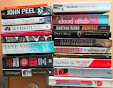
Sunday, 27 February 2022

Crossroads – Jonathan Franzen

Normally book reviews from the club have a “marmite” flavour reflecting the often contrasting views of individual members. Unusually though Crossroads was liked by every member and in some cases complimented very highly.


If there was one criticism raised it it was that (with 900 pages) it was too long but everybody was drawn into the book (as if watching a soap opera) and  stuck with it and in several cases are interested in reading the next two instalments.


Crossroads describes a dysfunctional family in 1970s midwestern USA who come together at Thanksgiving “at a pivotal moment of moral crisis”.


In an effort to keep our reviews as succinct as possible the group summarised their thoughts as follows:


Writing and dialogue

·      Was almost universally good.

·      Long and interestingly structured but easy to read because it had a strong narrative flow. The book was enjoyed because it read like an addictive soap opera.

·      Great descriptions of the decline and fall of the overly bright but pompous pothead son Perry and the mayhem such a life can cause.

·      It was rather compulsive reading-with a fluent, readable style with sufficiently strong storyline that you wanted to keep reading.


Characters

·      Intricate interesting characters with incredibly detailed portraits of their lives

·      Brilliant at getting himself into the minds of teenagers.

·      Captured the different stages of adolescence 15-17-19 very well and differentiated between them well.

·      Real and well developed characters.

·      The characters were so real there was so much detail and perceptive description of their thoughts and actions.

·      Great characters flawed yet likable a real sense of what is going on in their minds and bodies their perceptions and relationships the ups and downs of love affairs and of religious feelings. Build a very full,deep and interesting sense of the whole family and the people they interact with.


Relationships

Franzen is brilliant at relationships with each character’s webs all interlinking in a giant 3D silk sculpture… he describes all the parts of people that those close never get to know or at least fully understand and focuses on the minutiae of the small things of every day life which are fascinating despite all their intricacy, complexity and density.


Religion

·      The theme of religion runs through the whole book and the ideas and debates over the nature of religion Christianity and belief were enjoyed particularly by RV.

·      Most of all the book left Chris W with  questions about religion and particularly Christianity and its impact on its disciples and the complication it adds to people’s lives.

·      Many similarities with the strict closeted religious lifestyle described in education by Tara Westover.


Dilemmas

·      Full of real life dilemmas  anti-war yet personal morality not to dodge the draft, religious belief versus personal behaviour, love for children and an inability to give them what they want, sexual drive versus personal morality.


Family

·      Builds a very full, deep and interesting sense of the whole family and the people they interact with.

·      The underlying theme in the book is that nothing is more important than family.


Context

·      Many remarked how they were able to connect with many of the themes in the book which brought back vivid memories of their own experiences in the 1970s. 

·      MTs upbringing with his strict religious father-so much of my youth in this-my father’s church, youth club and its camps -lots of religion there and naughty things with girls such as snogging and kissing… listening to sermons at church, getting ready to follow a girl sitting in a far away pew afterwards-made it all worthwhile!

·      For SC it gave very vivid personal portraits, he enjoyed the descriptions of life in USA around the time when he was in his late teens.

·      MW memories of his church youth club in Bristol motivated obviously by all the attractive Christian girls that also attended!

·      For JH the author captured a time that had a huge impact on him when he visited and lived in the US-Franzen captured well both the big things such as the joys and tribulations of young love, pervasive presence of dope, the overriding influence of the Vietnam war as well as the little things in life such as the noise of a Maytag washing machine and of his Plymouth Fury car.

·      For CB it gave a good feel for the context of the early 1970s, the last stages of the Vietnamese war, smalltown America, poor conditions of native Americans, separated racial communities, the new vogue for openness (however manufactured).


Underlying Theme 

·      What is it to be good? Can goodness ever truly be its own reward or consciously or not does it always serve some personal instrumentality?

·      Very enjoyable musing on the nature of being good.

·      Can you be good by nailing your colours to a religious mast, or does it come more from inside? Arguably what Rick introduces to Crossroads has a more profound effect on most of the kids than any religious teaching-in other words, be good and interested in each other.


Drugs

·      Descriptions of drugs and Perry’s descent into serious drug misuse very well described and even the description of Becky when she is horribly stoned is well described.

·      The effects of drugs and paranoia is well described.


Negatives

·      Over- long and rather petered out at the end possibly in preparation for the next two volumes of the trilogy.


Scores

AA7.5

SC 7.5

CB 8.2

MW 7.0

CW 7.75

MT  8.5

JH 7.5

RV 8.5


Friday, 4 February 2022

Cloud Cuckoo Land - Anthony Doerr

Andrew had high expectations of this book as he’d enjoyed All the Light We Cannot See and the sense of place in About Grace. What he was hoping for was a work of great imagination and scope, with beautiful imagery that would take him on a journey - a magical mystery tour.

There are 6 main characters in 3 main storylines - Omeir & Anna in the 15th century, Zeno & Seymour in the 20th and 21st, and Konstance on a spaceship in the 22nd – plus Aethon forever travelling in the ether of time. Perhaps Diogenes’ manuscript is also a character.


And there are myriad connections between people and books and libraries and owls and oxen and centuries and plants and trees. Plus links between names like Arkady/Arcadia, Konstance/Constantinople, and Trustyfriend. 


Doerr dedicated the book to librarians and said it was his attempt at a “literary-sci-fi-mystery-young-adult-historical-morality novel”.


Andrew thought it was a fabulous fable, full of wonder, a beautiful jigsaw of a book whose disparate pieces fitted brilliantly together. A beautifully woven tale about the need to look after the Earth and each other. 


Not everyone in BBBC agreed.


With Aethon, soaring high above the clouds


Andrew, Steve, Richard, MarkW really enjoyed this book. It does require the reader to accept the magical world of Doerr’s story, but they all felt pulled into his world and engaged by the characters, and looked forward to picking up the book. 


Andrew and MarkT found the stories of Anna and Omeir beautifully written particularly how Omeir’s grandfather cared for him. Andrew liked the surprises with the spaceship being on the ground, Seymour with his owl windows, wanting to reveal the world as it really is, back to his angry environmentalist beginnings railing against the dodgy tech giant, and how the tension built towards the end. And the brilliant ideas such as Library Day, writing to every Rex Browning in England, Ilium as the nasty tech giant, and Zeno’s realisation at the end that the gaps in the story didn’t matter because the children’s imagination would do the rest.


ChrisB loved the Greek stuff, enjoyed the story of the book, loved the different places and times and thought it hung together well. He couldn’t stop reading it, even at bedtime, and it will stay with him for a long time. It was clever as it only resolved at the end, the sci-fi part was convincing as was the terribleness of war. He enjoyed the personalisation of the stories of Anna and Omeir on opposing sides. 


Steve loved the book, the twists in the strands of yarn and the links between them. It reminded him of David Mitchell’s Cloud Atlas, and he thought it was better than All the Light We Cannot See. Each storyline had its gripping individual qualities, particularly Zeno with his quietly tragic childhood, and his slow life shovelling snow until awakened by his recollections of the text that Rex introduced him to. He also enjoyed the rich and interesting supporting cast – a real achievement to keep this whole cast up in the air throughout the book. But for him it was Seymour’s story that most gripped and resonated - a tale of the 21st century: sensitive to the damage we are causing to our environment but not knowing how to channel it, and accentuated by his discovery of, relationship with and eventual tragic demise of Trustyfriend. So sad, so believable.  


Richard 
really liked the multiple story lines, the great sweep of the overall story and all the different characters held his interest. Some lovely turns of phrase and some lovely ideas. Doerr’s love of books and of libraries matches Richard’s (and MarkT’s) own and came through strongly, and the major descriptive passages (eg the transportation of the cannon to the walls of Istanbul) were superb. All the children had such rich fantasy lives. Doerr is very good on environmental damage, especially from the perspective of an autistic child, and very good on the logistics of sieges, and of moving huge armies.


Both Marks found the Constantinople part brilliantly written, with Omeir and Anna their favourite characters. For MarkW, the death of Anna probably the most moving episode of the book. Seymour’s early childhood and Zeno’s episode in Korea were particularly good, and he felt Doerr’s skilful writing made you care about the owls and oxen as characters too, as did Steve. MarkT was moved by Seymour and his owl and despite hating sci-fi grew to enjoy the Argos journey.  John also enjoyed and got deeply involved in the stories of Anna and Omeir, and the troubled life of Zeno Ninis, his fraught childhood and later life, but most particularly his love for Rex and all that flowed from that unrequited love. 

ChrisW did like many of the themes with Constance on the spaceship - they were thought-provoking and could have formed the basis of a book in its own right. The storyline about climate change, global warming, the decay of humanity was good and explained the need for Argos to boldly go to a new planet 659 years away. Seed banks, food printers, and the virtual reality Atlas library were interesting concepts as well as in a different storyline the use of Seymour whilst in rehab by the Ilium Corporation to edit out unpalatable activity captured by aerial photography.


All a bit cuckoo


However, for John, this book was a salutary warning that if you enjoyed an author’s earlier books it is no guarantee you will enjoy or even appreciate one of their later works. He saw it as an interesting collection of short stories ingeniously woven together, but in a way that was overly complicated and therefore not a satisfying read.  Not a book he would recommend.

John and ChrisW both felt it read as an authorial indulgence trying to weave a collection of stories together in a rather ingenious (or over-engineered) way.  Some ancient text being the possible common link between the stories or that many of the characters were facing imminent death at some point in their stories wasn’t enough. John pointed out Diogenes didn’t write the sort of stuff Doerr has him write in this book so why pick a real writer and give him a made-up book? He particularly disliked the spaceship part.


The book didn’t appeal to ChrisW at all - confusing, overlong, self-indulgent and followed a typical theme nowadays of taking a number of storylines and mixing them all up with a thread only being detectable at the end. He found the story of Seymour becoming an urban terrorist and being groomed online rather facile. He enjoyed the Constantinople parts, but felt that whole section of the book was simply about how the Diogenes scroll got to Urbino to then be referred to in the present day storyline. Some interesting themes but many unanswered questions.


Despite finding it 
a skilful, clever book, MarkW didn’t find it particularly memorable and thought it lacked substance with the gradual linking of the plots through the text ingenious but less successful. The main plot looked like science fiction but turned out not to be as they were still on the ground, and he was unsure of the purpose of the big scam but not sure if it mattered – was Ilium doing it for the government? It felt a bit Cloud Cuckoo Land, unrealistic. And it took him time to get used to the short chapters. 


MarkT loved All the Light We Cannot See so much that he bought the hardback of Cloud Cuckoo Land rather than the usual Kindle download but found the start bitty and confusing and hard to get going with all the different stories. It got better as he got to know the characters and he started to enjoy it, but found the short chapters and sense of time confusing and never quite got the one-page old bits.


Steve felt Doerr tried to cover too grand a scope of issues and there were too many unbelievable factors crowding in as the book reached its climax. What, for example, was the true reason for faking the Argos voyage? Something vague about a secret plot to conceal the true magnitude of the catastrophe about to engulf Earth?  And just how far can a man in his 80s sprint with a backpack in a few rings of a phone?

Richard felt the start was slowish and when he was half-way through, that the main characters all had the same voice, but they then started to separate out better. He also wondered why the book was written – the two Constantinople stories were excellent, but their main purpose seemed to be to enable the book to be discovered and then taken to Italy. And Zeno’s purpose was to translate it. And Konstance’s purpose was to continue that telling of the same story, so it goes through the generations.


This Land is our Land


Andrew thought Doerr gave us a glimpse in the spaceship of our forthcoming metaverse - with all the teenagers on their Perambulators in their quarters but brought together in the library through their Vizers - all moving around and talking to each other, exploring books and places and playing games. MarkT pointed out that AI is only as good as its programmers.


Andrew also thought that the ending when Aethon realises he appreciates his sheep and the simple things in life more than the utopia he has sought, may have been a hint that we should abandon our consumptive lifestyle and concentrate on caring for our planet in the here and now – perhaps keeping the manuscript safe is a metaphor for our need to do the same for the Earth (and each other). Perhaps the link between Diogenes’ book The Wonders Beyond Thule and Qaanaaq in Greenland (formerly known as Thule or New Thule) was also a hint that Greenland might soon be one of the few habitable places on earth? “The world as it is is enough.” might be the message of the book.


Printed food for thought


Why pick a real writer like Diogenes and give him a made-up book? - JH

Who were the 49 other inhabitants of the island? - CW
How was Constance pregnant? - CW
Was it a virus? - CW
Had humankind been totally destroyed? - CW

What was the point of the experiment with Argos? - MW

Did Seymour actually kill Zeno? - MW

Life on Argos – what was real? - MT

Was the virus on board a sham? - MT

Why was the Argos still on the ground? - RV 

Did Google used convicts to test the original? – SC

And just how far can a man in his 80s sprint with a backpack in a few rings of a phone? - SC 


Bath, England, a week before Christmas, 2021


And to end on a topical note, Steve commented that the day he read the passage where Konstance’s friend Omicron was introduced, the name of the currently rampant Covid variant seemed to enter the general media conversation. That was only three weeks ago. 


Scores

AA – 10

CW – 5

CB – 9

MW – 8

JH – 5.5

SC – 9

MT – 7

RV – 8.5

WM – get well soon


The Promise - Damon Galgut

Most of us liked this book and found it an easy read but were surprised that it won the Booker Prize. Despite this, we all had a lot to say about it! 

The Promise is a short book that tells the story of a white family across 40 years in a quartet of places, times and seasons in the last days of the apartheid regime in South Africa and the early years and present day of the new republic.  Spring of 1986, Winter of 1995 (world cup), Autumn of 2004 (Aids crisis), Summer of 2018 (resignation of Zuma) which is reflected in one of the characters, Anton’s unfinished novel.  

For most of us, the book grew on us. Some struggled with the style which was jarring switching between tenses, time and characters like a stream of consciousness commentary. It seemed very much written for a South African audience with a few in jokes and references to stuff that one either just took as read or one had to do a bit of research.

Often it is unclear who the unnamed narrator is. Is he part of the story? But some liked the fact that the narrator often makes quips to the person to whom they are addressing the story and even makes judgements on what they are thinking sometimes accepting that they are racially biased. Mark found it cleverly written, and funny in places, and easy and a pleasure to read. Steve was even more positive: it was beautifully written - unassuming and direct, yet full of vivid imagery and breathtaking situations that just leap out right in front of you, like Astrid’s final encounter. It was also very funny in places.

The thing that Steve took away most strongly is the way the style deceives the reader into thinking this is just a simple story about a family changing over the generations. But gradually you realise how big the issues are. How Amor devotes her life to caring for Aids victims as the disease takes hold in South Africa and continues to fight for Salome’s promised bequest all through the book. At the same time Anton is gradually losing it, morphing from lovable but reckless prodigal to sad waste of space, but intelligent enough to know it. And the farm becomes a metaphor for the decline of white South Africa. 

We liked the way it started with Amor, and ended with her as well, the surviving sibling, bracketed by her first period at her mother’s funeral and the “drying of her channels” at the end. Perhaps the promise of the book is that of the rainbow nation and how it has not been realised. Has Galgut intentionally linked the story of the new nation to the arc of one woman’s fertility, starting with huge potential and then petering out. 

All the family members except Amor are part of racist and white supremacist culture of the dominant Afrikaners. There is some excellent writing that expresses the emotions, thoughts and hang ups of each family member and the fractious relationships between them all. Each character is drawn with its own idiosyncrasies and madness. Andrew highlighted nice descriptions of people at night trying to sleep and people’s internal dialogues intertwined with dialogue. Richard highlighted Galgut’s very good treatment of the shock of bereavement.

Mark W noted that religion takes a bit of a battering as well. All religions are treated with the same degree of disdain, from Dutch Reformed to Roman Catholic. The theme (and hypocrisy) of religion crops up throughout the novel at each burial and shows the Pastor progressively developing his own private offshoot of the South African Anglican church to which the father becomes completely taken in. And Astrid justifies her adulterous lifestyle by turning to Catholicism which relieves her of the guilt of her sins.

We appreciated how the book portrayed recent history in South Africa. Mark T: The sense of South Africa was good, the ending of white rule and the birth of the new country and the decay, violence and fear were well described. The closed minds of the Manie and Astrid and others contrasted with the vision of Mandela and Tutu who realised that replacing one tyranny with another was not the way forward. 

Each of the family members are on the brink of madness, even Amor whom the others all think is the strange one. Just as their society is on the brink of massive change, their source of income is drying up and their right to live on the land is challenged. A story of disintegration only slightly redeemed by Amor’s very belated gift to Salome which also frees her from her history, the promise finally kept. As each of the main family members dies, each has reached a point of disintegration from cancer, from grief, from an ordered society, from hopelessness. Only Amor in her limited but compassionate life as a nurse, leaves the family, the farm and can see a future.

None of the characters are likable and none except, Amor have any redeeming features. This includes the minor characters showing for example a corrupt religion led by the domninee. Was this to emphasise the bankruptcy of the white society? Only the excellent descriptions of people, places, relationships and mental commentary prevents the book form becoming a depressing dirge. Perhaps, deliberately too we only get small snippets of what the black characters in the novel are thinking from Salome to Lukas to Lexington. Why make most of the black characters so negative too?

Richard: One of my problems was that this was such an odd family – although the initial description of the parents made them seem relatively ‘normal’ (although with all the stress of marrying across different cultures and religions), what emerges is that all the children are really odd, and the ways that everyone communicates (or not) are equally odd.

Richard: One of his recurrent themes was death – not only and obviously that each section revolved around a key death in the family, but his descriptions of death, and the process of bodily deterioration after death.

Richard: There was a lot of mystical material and/or magical thinking in the book, and I did not understand the place of it in this book. Richard: often I did not know where the book was going or what its point was. 

Andrew: In the end, I’m left with a slightly deeper understanding of South Africa, some forgettable characters, and disappointment that the style celebrated by the Booker judges detracted from the story. A bitty, scratchy book, but with layers and weaves of powerful imagery about the promise of the rainbow nation and with bursts of power and beautiful prose.

Chris W found it a very thought-provoking book and one which he would like to read again.

Steve: It’s an interesting book that, for all its darkness and death, ends on a positive note - the final sentence I found particularly effective, as Amor leaves the farm for the last time. That felt like moving on at last from the mess created and complicated by her family. But so tragic that while the promise is finally fulfilled, the reception she gets from Salome’s family is suspicious and bitter - lives wrecked and potential wasted.

Scores

Richard 4.5
Steve 7.5
Mark T 7.75
Andrew 7.5
Chris w 7.75
Mark 7
Chris B 7


Thursday, 2 December 2021

Hamnet – Maggie O'Farrell

Meeting venue: by an open fire in Mark W's living room, 4th November 2021

This is a simple story in many ways. It is a very ‘human’ book, not political, and, although classed as a historical novel, it’s not really historical in any other sense than that it is a reflection of the lives of fairly ordinary people at the end of the 16th Century – possibly one of its charms.

As we know, it centres around the death of William Shakespeare’s only son, twin to Judith and younger sibling of Susanna. What is interesting, and perhaps contributes to the uniqueness of the book’s viewpoint, is that it relegates Shakespeare himself to bit-part player, (as he was in real life while running his company). He is never named, so the baggage his latter-day reputation brings with him doesn’t overshadow the story Maggie O’Farrell wants to tell.

This story is that of Shakespeare’s wife, Agnes (who we know as Anne Hathaway), of the quite commonplace death of one of her young children in a modest town house in a Midlands market town in 1596, and of the way this affects her and the family around her.

The book received a broadly positive reception from the BBBC, and scores ranged from a not bad 6.5 to a positively euphoric 10! Steve, whose choice it was, had read it before and he had a comment about the wisdom or otherwise of re-reading a book that you enjoyed first time round, which will be appended to the end of this summary.

Things we liked:

  • An elegant, accessible prose style that didn’t get in the way of the story and was a welcome relief from some of the somewhat heavier-going fare of recent months (JH). It was pleasing to note that historical novels didn’t always have to be as impenetrable as some previous club reads such as Wolf Hall, for example (MT).

  • The structure: the two principal narrative strands (young Agnes, older married Agnes) were cleverly woven together; no-one found this a permanent obstacle though some said it took a bit of getting used to.

  • O’Farrell’s ability to create vivid, believable characters was remarked upon. Brother Bartholomew was cited by MW, AA, CB as a character they particularly liked, but all members of the Shakespeare family were well-formed, distinct and believable. Her descriptions of the details of everyday family life were powerful, not least around her existence at the farm before getting together with The Latin Tutor, when he sees her across the fields with her falcon. Several good words for the apple-shed encounter as well! 

  • Likewise the author’s ability to write convincingly about the almost shamanic relationship Agnes developed with the natural world around her – so she became someone the townsfolk of Stratford respected, though at the expense of good relationships with the more traditional medical experts in the town. The appearance of the doctor in full quarantine paraphernalia was vivid and effective, incorporating a hint of humour. 

  • Fantastic, lyrical descriptions: ‘’Night-time in the town, a deep, black silence lies over the streets, broken only by the hollow lilt of an owl, calling for its mate. A breeze slips invisibly, insistently through the streets, like a burglar seeking an entrance. It plays with the tops of the trees, tipping them one way, then the other. It shivers inside the church bell, making the brass vibrate with a single low note. It ruffles the feathers of the lonely owl, sitting on a rooftop near the church.’’ (CB)

  • Almost everyone commented on the amazing description of childbirth, when Agnes takes herself into the woods, watched over by the spirit of her mother, to give birth to Susanna: 

  • “Nothing, however, could have prepared her for the relentlessness of it. It is like trying to stand in a gale, like trying to swim against the current of a flooded river, like trying to lift a fallen tree. Never has she been more sensible of her weakness, of her inadequacy. She has always felt herself to be a strong person: she can push a cow into milking position, she can douse and stir a load of laundry, she can lift and carry her small siblings, a bale of skins, a bucket of water, an armful of firewood. Her body is one of resilience, of power: she is all muscle beneath smooth skin. But this is something else. Something other. It laughs at her attempts to master it, to subdue it, to rise above it. It will, Agnes fears, overtake her. It will seize her by the scruff of her neck and plunge her down, under the surface of the water.” (RV, SC) 

  • O’Farrell’s deep dive into the complexities of human emotion. Agnes, living without the man she loves by her side, becomes prey to private uncertainties and fears about what he might be up to in London, especially once he has torn himself away after the funeral (a powerful scene): “It’s as if her mother needs London, and all that he does there, to rub off him before she can accept him back, Judith observes”. AA pointed out that people would have lost close relatives more frequently than now – however O’Farrell has herself remarked that maternal grief would have been no less powerful for that fact. 

  • The passages leading up to Hamnet’s death were memorable – particularly in which the bed is brought downstairs to the fireside in a desperate attempt to sweat the fever out, amid arguments over which remedies might work, and which were useless (dried toad, for example). Our medical consultants assure us that the descriptions of the physical effects of bubonic plague were ‘spot on’ (AA) 

  • The powerful climax of the book involving the trip to London to confront her husband – cleverly presenting the mayhem of London life through the eyes of a ‘simple country girl’, as she realises that his presentation of his play ’Hamlet’ is his own way of expressing his grief, that he is as profoundly affected by Hamnet’s death as she is, but that he has found his own individual way to deal with it. This is the only point in the book that there’s a form of homage to Shakespeare’s own talents. 

  • The ending: neat, revelatory and satisfying for many of us – a much better ending that some more laboured efforts we’ve read in the past. 

  • A number commented on the fact that the book had additional topical resonance (though this could not have been an original intention of the author) through the parallels with the current pandemic. Quarantine, theatres closed by order of the Queen, no-one allowed to gather in public… 

  • O’Farrell’s ploy of removing William Shakespeare to the list of bit-part players – never naming him other than by what he meant to her: The Latin Tutor, for example, latterly ‘husband’. This for most had the effect of enabling us to concentrate on the story of a woman living a hard, sometimes desperate life, yet striving at the same time to be fulfilled through the lives of her children, her husband and through the use of her own undoubted intelligence. We felt that this was an original and eloquently expressed representation of such an ‘ordinary’ woman’s life in the late 16th Century.


Things we were less convinced about:

  • The chapter dealing with the passage of the plague-carrying flea from Venice to England was enjoyed by some as adding additional colour and depth to the story, but others found it a pointless digression, adding little and not telling us anything we didn’t already know. 

  • The ‘spoiler’ at the start, in which it is stated that the child dies, took a couple of members by surprise, as they were unaware of the back story of Hamnet’s death. However, for others, this in no way detracted from the enjoyment of the story as it was for a number of us already known; indeed the fact had been a central part of the book’s publicity at launch as O’Farrell made it clear that it was learning the fact of Hamnet’s death at school that started the thought processes leading to writing the book. But it demonstrates the dangers for publishers in making assumptions about the level of historical knowledge of its potential readership. 

  • The degree to which Agnes descended into the depths of grief after Hamnet’s death was seen as over the top by some. RV: ‘I was happy to return to read it, it was an easy read; and yet, over-wrought in places... Obviously I am aware that grief can do terrible things to people, but this seemed SO extreme, especially given that up to 50% of all children did die in medieval England before reaching puberty, that the death of a child would be not exactly commonplace but largely expected. Yet both she, and WS, are so overcome. So I’m not totally convinced by both of their terrible, mind-altering grief, as child death was so common.” As mentioned, O’Farrell has defended this by saying that maternal response would not necessarily have been diminished simply because of the higher incidence of child death.

SC at times had some sympathy with Mary: “Mary, Susanna knows, is of the opinion that grief is all very well in moderation, but there comes a time when it is necessary to make an effort. She is of the opinion that some people make too much of things. That life goes on.”

  • Some suggestion (JH) that O’Farrell’s presentation of the hazy ‘facts’ around the death were rather manipulative – she marshalled the information very much to meet her own ends. Arguably however this is what authors do – particularly crime writers, who drip-feed the key information through as it suits them.

SC’s response to re-reading the book for the club was that he rather wished he hadn’t. The second reading made him more critical – of things like the use of present tense; of the extreme depths of Agnes’ at times seemingly endless grief, for example, whereas at the first time of reading he had found himself totally engaged, captured, absorbed by the book.

An appropriate final word comes from JH:

‘The final pages of the book were extraordinary – particularly the way that the battlement scene in Hamlet is used to share a parent’s grief “Hamlet, here, on this stage, is two people, the young man, alive, and the father, dead. He is both alive and dead. Her husband has brought him back to life, in the only way he can. As the ghost talks, she sees that her husband, in writing this, in taking the role of the ghost, he has changed places with his son. He has taken his son’s death and made it his own; he has put himself in death’s clutches, resurrecting the boy in his place.”’ 

We did, on the whole, like the book, some of us very much indeed. All of us found something to appreciate, and it ended up being one the better-scoring reads of recent years, logging an average of 7.92.


Wednesday, 24 November 2021

The Yiddish Policeman's Union – Michael Chabon

Meeting venue: The Ring-O' Bells, Widcombe, 7th October 2021

This is a book which is set in an alternate universe – one where the State of Israel lost the May 1948 War of Independence, and hence where Israel was overrun, causing a humanitarian crisis which of course relatively immediately followed the crisis caused by the Holocaust, and leading to the USA offering a portion of Alaska as a temporary homeland, leased to the Jews in a similar way to Hong Kong being leased to Britain, with the contract specifying a date on which it would be returned. That date is a few months away – the ‘Reversion’. In this Universe, this ‘Jewish State’ is policed by a Jewish police service, and the ‘hero’ of the novel is a detective in that service. The book tells the story of his investigation of a murder.

Richard chose it because a (non-Jewish) friend of his highly recommended it.

Although as is usually the case many could see both positives and negatives within this book, the BBBC split into three over it.

On the one side were three of us (ChrisW, Richard, ChrisB) who felt that despite some drawbacks, it was essentially a very good, or even an excellent book (scoring two ‘8’s and a ‘7’); on the other, there were three (MarkT, Steve, Willm) who actively disliked it (scoring a ‘3’ and two ‘3.5’). And finally there were three (John, MarkW, Andrew) who liked elements of it but were neither as positive nor as negative (scoring 5.75, 6 and 6.5).

In sum, the negatives revolved around: hard to follow, slow to get into it, too difficult to get into this alien world (You can't participate in the game if you don't know the rules), not really gripped by the characters, not than interested in a Chandler pastiche, the language and syntax and Yiddish slang words.

The positives revolved around: the language, the style, the fact that it was a Chandleresque detective story, the themes, the fact that it was an alien world (customs, traditions, language) into which one could get transported, the characters and the relationships – its enjoyability and entertainingness.

The Negatives
Two BBBC members who actively disliked the book did not complete it. The third found many positives, but still ended up actively disliking it.

Willm: I have a contrast in view to those who liked it. I didn’t get on with it at all. Clever turns of phrase, but why? Why write a book: a pastiche of Dashiell Hammett or Raymond Chandler. The movies are great but why write a book? The Jewish material just passed me by. I gave up after 45 per cent.

MarkT: I agree with all of the negatives. I liked the bit from Tess of the D’Urbervilles but it was such a relief to stop after 100 pages.

Steve: The author creates immediate impact through a Raymond Chandler-like downbeat voice and applies similar laser-sharp wit; sometimes the humour is almost Wodehousian. In fact, there was masses of powerful, in your face imagery, although sometimes I felt that he was maybe just trying too hard. Chabon’s ‘reality’ is presented so matter-of-factly, unarguable, it’s as if he believes he doesn’t really have to explain himself. Instead, the back story is drip fed, so while you get (some background) early on in the book, you don’t get other key background context until later. So you gradually get to fill in some of the yawning gaps in one’s understanding, but that’s still being fed in right up to the end. In a way one experiences a more acute form of the frustration that you sometimes experience when a writer is withholding information from you simply to spin the story out - which obviously happens with any fiction, but some pass it off better than others. I really wanted to know where I stood with the background story so I could get properly stuck into the actual plot. There were too many distractions fighting for attention. For example, for all my life the word ‘Yid’ has been considered an unpleasant insult, but there must be degrees of subtlety here that I’m missing. However, I was sometimes transported wholesale into this surreal world Chabon creates. Sitka is a real place, in Alaska, near to where Jonathan Raban sailed and wrote Passage to Juneau which we read a few years back. Also Snow Falling on Cedars. Interesting that that book centred around the true story of Japanese immigrants and refugees. So I could visualise the landscapes, even if much of the detail was outlandish. The (to me) alien world of Orthodox Jewish life stands as a barrier to more complete understanding - the passage involving the visit to the ‘boundary maven’ for example was so loaded with ‘specialist’ information that I was learning for the first time, much of it involving string, that it was very difficult to decide what to hold in one’s head as important detail for the sake of the story and what to treat simply as simpler background context. The significance of the painted red heifer completely passed me by, for example. I fought a sense of inadequacy, that I should know and understand more. And I experienced, as already mentioned, a frustration that there were too many questions raised at every corner - that this unnecessary complexity got in the way of a good story. And of course this was compounded by the embedding of the story in the world of chess, a game I have never mastered – though as it turned out, knowledge of the game wasn’t as critical to an understanding of the outcome as the understanding that for some people it’s a matter of life or death. 

I don’t often check on the web to see what other people thought of it. On this occasion I did, and found a review by Adam Mars Jones in The Guardian, from 2007, who sums up one of my main issues with the book well: ‘The real problem with the book is the piecemeal way Chabon introduces his alternate reality. It's an unwritten rule of the genre that you should be able to define the difference between the parallel world and ours in a single sentence... …No such establishment of a baseline is possible with The Yiddish Policemen's Union. Two million European Jews were slaughtered in the 1940s, rather than six, and there's no reference to Hitler or any other political figure (the current American President is referred to only in those vague terms). No doubt Chabon has compiled a little dossier or chart of his world, but there are readers who would like a peek, too. You can't participate in the game if you don't know the rules.’ 

So in the end, the only thing I felt really drove me to finish the book was a desire to find out if Naomi really was dead, or if she’d manage a miraculous resurrection (stranger things happened in the book). So I had to mark it down because of the disappointment. In a sentence: mercurial flashes of brilliance but too self-indulgent and free with the in-jokes to carry a gentile like me wholeheartedly along with it.

The Positives
ChrisB: A rollicking detective story, very Chandleresque, very enjoyable, a neat style. I liked the story, the pursuance of the “who murdered …” theme, and the back-story – his relationship with his father, his candidature to be his generation’s messiah. Not sure I understood why Mendel Shpilman got killed. There were some amazing turns of phrase: “he fears he suffers from tinnitus of the soul”.
Overall, rather a fun book despite its heaviness. A book I will remember.

Richard: I liked lots about the book: it became more about chess and about history, and I love both of those; it started to appear to me as an interesting and a complex book, with complex characters, many of who I could like, and even understand; I found a lot of aspects of the book interesting: the politics, the idea of what might have happened if Israel had lost the War of Independence, the relationships with the USA, the desperate yearning by the Jewish people for a permanent home, and then on top of all of that, a murder story and a detective story, and then chess, and add in complex Jewish sects, and then the style. I thought the main characters were quite strongly drawn – Meyer Landsman, Berko Shemets, Bina Gelbfish, - even Frank (“Mendel Shpilman”) starts to come across as a strong character. And there were a host of more minor characters that also stood out strongly – Willy Dick, Rebe Shpilman, many others. The politics are really interesting: the issue of a Jewish Homeland was such an important one for so many generations, and it is interesting to see how relatively less important it is now that Israel is a (relatively) unassailable fact. So this story postulates a situation where the Jews are still searching for a homeland, and the issue of what will happen after ‘the Reversion’ is a burning one. The way that modern Hebrew was thought about in the book. And I thought that the style was rather marvellous. His use of words and metaphor and simile was simply superb – almost every page had on it something that was striking and unusual, and sometimes beautiful. I found them really clever, unusual and apposite. 

ChrisW: agree with Richard and ChrisB. A weird book: I had two reinvent invent my understanding. I loved this introduction into a different world, very Germanically Yiddish. I’d bought into the film noir, the seediness, damp, cold rainy environment, the intensity of religion and the deals. I found the relationship with his wife very touching and well explained, the implications of the reversion, the USA involvement. His command of words, very funny, all these customs, the enlightenment into Yiddish-ness, and into a different locality and culture. I liked it, very entertaining, I wanted to go to bed to read it.

The in-betweeners
Andrew: There were many positives. Chabon captured well the New York cop writing style and world-weary, harsh dialogue; The book read Like Philip K Dick transplanting the “frozen Chosen” into a Raymond Chandler detective story; Chabon is great at painting quick pictures; and great descriptions – particularly his use of metaphor - and the terrific description of Rabbi Shpilman – like clay lumped together by blind orphans etc. However, it’s quite a complicated writing style which often gets in the way of flow; there is a huge cast of characters (with the main ones well-drawn and interesting but not particularly compelling or making me care, except perhaps for Berko); and I spent too much time looking up words and translating from Yiddish which spoiled the flow. I thought that it had a great start with the very first sentence: “Nine months Landsman’s been flopping at the Hotel Zamenhof without any of his fellow residents managing to get themselves murdered”, there was the clever twist of Landsman finally telling his dad he hated chess in a letter and his dad killing himself 2 days later: Landsman then has 20y of guilt before he finds the letter again – unopened! But it was overcomplicated and knotty at times and I got bogged down a few times in the first quarter until it took off once we’d met Mendel and then his parents.
I thought the book was far too long until I got to halfway and realised that a big worthwhile story might be unfolding and how pleased I was that there was still half the book to go rather than just a couple of chapters of wrapping up and denouement - finally felt part of the world of the story …. at the same time as feeling pissed off that it had taken half the (very long) book … but in fact although the scope of the story soared to include global events, it never sang and whizzed along, always dragging a bit and for me slowed down by looking up too many words I didn’t know.
Overall, enjoyed the plot and Landsman and some of the other characters; I enjoyed the writing and the way Chabon saw people and things and his descriptions of them; but it was too long and too slow; there were no characters to care about; and it never zipped along like Shuggie or A Gentleman in Moscow - a bit like cycling on cobbles … But with some sharp writing.

Mark W: Another book that I found really hard getting into. This time I really struggled with the first fifty pages or so but, for some reason, the chapter where Bina returned as Landsman’s boss was a bit of a turning point, perhaps because it gave an additional element to the narrative (the relationship between these two) that sustained my interest to the end of the book. In fact this element, rather than the whodunnit and whydunnit elements was for me the most interesting part of the book, probably because the rest of the characters were pretty uninteresting, apart from the partner Berko. Having said that, I still found the narrative pretty hard to follow but I’m not really sure why that was, possibly because I struggled with some of the language and syntax, and not just because of the plethora of Jewish slang words thrown in. The story seemed a bit confusing to me, and the revelation at the end when the murderer was revealed was a bit of an anticlimax. The idea of this Jewish community in deepest Alaska was an interesting one though and there were some interesting ideas, notably the rabbis acting as all powerful mafia style bosses. Whether there is any element of reality in this would be interesting to know. All in all, not bad after a slow start but difficult to follow and a fairly far-fetched whodunnit. Preferred Tulayev and Sympathiser.

John: I really liked the premise that the book is based on – an alternate history in which the Jews were expelled from the new state of Israel in 1948 and forced to make settlements in other parts of the world. Many of the Jews of Europe finding a refuge of sorts in a cold corner of Alaska - Sitka. This apparently was a makeshift solution as it was expected that Europe would in due course take them back, but now this District itself is about to revert to America. A source of much consternation and which seems to be backdrop to this story. I think I followed the story, but it was hard - what with the complex mix of characters and the variety of cultural, religious and linguistic hoops to hop through and around. All sorts of digressions and detours that added to the confusion – the murder of Landsman’s sister, a fake drug treatments centre in the middle of no-where with a suspicious red heifer which will help Jews to reclaim Israel, and the arrival of US Federal Agents who block the investigation in order to help bring about the “return” of the Christian messiah. Wow…… all very complicated and often hard work. It was not an easy read partly because of its complexity and partly the rather world-weary tone it was written in – a homage to Raymond Chandler or Dashiell Hammett I assume. But there were moments when the story took off at a pace and gripped you. It would then seem to get bogged down again in some arcane detour. As one reviewer noted this book was at various times everything from an elaborate joke to an unwieldy bore. But there some wonderful lines that stood out from the melange.

Almost everyone (even those who did not like the book as much) had interesting quotes which they brought, to demonstrate this author’s way with words; and there were so many to select from that in all of the quotes people brought, there was only one overlap!

Some choice quotes were:
• like goldfish in a bag, about to be dumped back into the big black lake of the Diaspora
• In drafty, tin-roofed huts and barracks, they underwent six months of intensive acclimatization by a crack team of fifteen billion mosquitoes working under contract with the U.S. Interior Department.
• A trace of a double chin that Landsman puts down to a vanished life as a fat boy.
• They leave Brennan standing outside the Front Page, with his necktie smacking him on the forehead like a remorseful palm
• the beaded curtain clatters behind her with the sound of loose teeth in a bucket.
• He has the memory of a convict, the balls of a fireman, and the eyesight of a housebreaker
• The round tables that crowd the stage wear overturned chairs like sets of antlers
• Rain tossed in vandalistic handfuls at the windshield.
• Bina accepts a compliment as if it’s a can of soda that she suspects him of having shaken.
• Mrs. Kalushiner comes back, dragging the great leg iron of her life.
• In a narrow window opposite the cot, metal-slat blinds leak the disappointed gray of a November afternoon in southeastern Alaska. It’s not light oozing through so much as a residue of light, a day haunted by the memory of the sun.
• Landsman is at the wheel of a 1971 Chevrolet Chevelle Super Sport, which he bought ten years ago in an access of nostalgic optimism and has driven until all its secret flaws seem indistinguishable from his own
• Ahead of him rise the tower blocks of the Shvartsn-Yam … huddled in the darkness like prisoners rounded up with a powerful hose
• and a bunch of bohemian semiprofessionals who like the atmosphere of ruined festivity that lingers in the neighborhood like a strand of tinsel on the branch of a bare tree
• “You,” she says, making a face like she just tasted earwax on her fingertip”
• Several inches remain in the bottle when he is through, but Landsman himself is filled top to bottom with nothing but the burn of remorse
• Girls hobbled by long skirts go along braided arm in arm, raucous chains of Verbover girls, as vehement and clannish as schools of philosophy
• His full ashy beard flutters in the wind like bird fluff caught on a barbed-wire fence
• He’s too superstitious not to see this as a bad omen, but when you’re a pessimist, all omens are bad
• Every generation loses the messiah it has failed to deserve
• It never takes longer than a few minutes, whenever they get together, for everyone to revert to the state of nature, like a party marooned by a shipwreck. That’s what a family is
• As it happens, I told Chief Inspector Vayngartner how you had just been shot.” “And he said?” “He said that in light of this fresh evidence, he might have to reconsider long-held atheistic beliefs.”


Sunday, 3 October 2021

The Case of Comrade Tulayev - Victor Serge

WM (who selected this book): 

Victor Serge was a lifelong revolutionary - moving through every proletarian battle of the first half of the 20th Century, as he saw the failures of each bellief.  Not staying with any particular orthodoxy saw him imprisoned, ostracised, lionised, and eventually dying in poverty but not despair.

This is his final book and it illustrates the nature of terror in a totalitarian state (a term he coined for the USSR).  All this is demonstrated without a lot of overt violence or descriptions of physical torture.  The recognition in everyone’s mind is that they could be arrested at any minute, tried, and executed. Whether they be old revolutionaries, bureaucrats, workers, or anyone in any way associated with them.  And the vast majority of these people were true believers in the socialist state and the glorious future to come - why they could be convinced to confess to crimes impossible for them to have committed.

However, many chapters include lyrical, beautiful, poetic descriptions of the natural world, the night sky, the sparkling snow, in contrast with the closed, physical, mental, emotional poverty of the people.

The novel itself is almost a succession of essays all linked by the perceived ‘plot’ to murder Tulayev.  The last chapter, for me, has a qualitative different feel, almost romantic, as Kostia re-emerges, but reverts to fear as the truth is revealed to Fleischman, and the final paragraphs where all the functionaries are simply faceless men as the army marches by.

JH: 

Not an easy read – dense – hard to follow with the different characters and why they are there. Sontag’s Introduction says 'a polyphonic novel with many trajectories'  – in other words, hard to follow.  I gave up after 120 pages and speed read the rest. 

However it captured the absurdist nature of Stalin’s Russia – the depth of paranoia and acceptance that individuals had little control over what was going on, as well as a bizarre faith in the cause, the party and Russia.  As Rublev says 'it is better to die dishonoured, murdered by the Chief than to denounce him to the international bourgeoisie…' (p.71)

The book also provoked me to think more about the awfulness of such a regime (Stalin’s 1930s purges: c.700,000 executed, c.1m+ dead in gulags). Compared to Comrade Tulayev, Koestler’s Darkness at Noon is a much easier read as it does not suffer from poor editing, dodgy translation and is focused on one individual’s experience, whereas Serge’s novel is more about the convoluted contradictions and the wider context in which these purges took place – which may explain its complexity and why it is far less known.

SC: 

A very challenging book and certain aspects of the prose pushed me to the point of giving up, but it seemed too important to dismiss lightly.
It was a sporadically fascinating historical document. The insights into the bleakness of life in the USSR in the 1930s were often powerful. The early passage told by the prostitute about the poverty her family experienced, and Makeyev’s rise and fall from minor rural official,
‘He felt himself, like them, possessed of a legitimate authority, integrated into the dictatorship of the proletariat like a good steel screw set in its proper place in some admirable, supple and complex machine’

Interesting that the vast majority of characters are male bullies and most of the females are compliant partners playing the traditional and often quite sexually descriptive role - but there are exceptions, Zvyeryeva for example

However, I found the structure of the book confusing, and as with every Russian novel I have ever read, the names were an impediment to fluent reading and absorption of the plot. After a while I gave up worrying about who was who and just ‘enjoyed the scenery’.

There were undercurrents of Kafka, and George Orwell. I was also strongly reminded of Armando Iannucci’s film, ‘The Death of Stalin’, which covered similar ground though not so much from the perspective of the ordinary person.

I think, overall, we’ve moved on as a society. It’s an interesting book as a historic document and perhaps a dire warning. It didn’t feel particularly relevant to 21st century global society. 

AA:

Published in 1947 in the aftermath of WW2 so perhaps not surprising it appeared to lack careful editing. Written at the same time as 1984 and 15 years before One Day in the Life of Ivan Denisovic. Sontag’s intro was quite interesting but far too long.

Great start with Kostia going shopping and description of his and Romachkin's rooms and Romachkin with the destitute prostitute.  Each new chapter introduced a new official who I never felt I really got to know

Really enjoyed the scene of Erchov being sent a private train to collect him and his wife and the unscheduled stop in the middle of nowhere where he was divested of his post, his power, and his uniform in a room with his portrait on the wall.  The whole toxic terrifying mess of the Party comes through strongly, with similarities to The Sympathiser, but too repetitively: 'To hell with my and me, to hell with self, to hell with truth, if the Party can be strong!'
So despite some beautiful descriptions I began to find it dull and just under half decided to stop.

CW: 

I can’t say I enjoyed this book, but it’s very well written and the individual chapters describe vividly the reach and control of the Party and the all pervading fear and worry of Russians who cannot trust even their closest relatives. Some descriptions such as a freezing Moscow street at night with snow blowing around the street lamps were beautifully described and I liked that there were many different scenes with different characters all living under this terrifying political system. As the book progresses and more and more characters are removed and liquidated one becomes almost blasé that only half of the characters remain by the end of each chapter.

Particularly liked the chapter about Makeyev who was born a peasant and who rose to the very highest ranks through chance and  his ignorance .

Whilst clearly a magnificent novel in 1947 I feel that it has lost something today because so many of the names referred to were unknown to me and had no historical connection. Coming just after the end of the Second World War it must’ve been compelling reading to hear in detail what had been going on in the Soviet union while America and Europe were enjoying the roaring 20s followed by the Nazi build up to the Second World war.
How much better is the Russia of today with Putin? And China, North Korea, Belarus. State control seems to be getting stricter and stricter. The only difference being that they are capitalist Communists.

CB: 

I really enjoyed so much of the language, with fantastic use of metaphor and ideas. Great insights into the human condition and especially life in urban and rural Russia at the time. It also conjured up the terrible pressures and fear during this period of Soviet history. The sense that anyone in power could easily find themselves in a reverse position overnight.

However, it was a difficult book to follow with characters departing the stage and then re-emerging later, though the beginning and end with Kostia and Romachkin did bracket the book well.

It felt like the book needed a good edit. some stories just went on too long with too much verbiage. And many sentences did not make sense (probably poor translation).  So it was a soporific book to read at times.

I did like the distinctness of some of the characters, especially Makeyev,  and the presentation of Stalin himself was realistic and cogent.  And some lyrical sections: “The slumber of the moon-drenched forest finally impregnated the old man and the grown-up children with such vast quiet that it seemed to cure all ill

Whilst the book refers to a particular point in history in a particular place, it resonated with many other totalitarian regimes that we have heard of. And some of the creeping assault on civil liberties within our own country, though so far much less radical, are signs of a society moving in the wrong direction as far as freedom of the individual and democracy are concerned.

MT: 

Struggled with the book, the introduction really long and tedious. I found the start ok, with the story of the room (!) mates but after that it became very confusing to me and I mostly had little idea what was going  on and what the various connections were  I am at an early stage so of course it may get better so I will try and read a lot more over my travels in the next couple of days. I could not relate to any of the people, situations or women in the book so far.

RV: 

The main problem was that I felt that this was a polemic pretending to be a novel. The author told us a lot about the brutality, injustice, paranoia, servile attitudes (but not surprising else one ended up dead oneself), and downright awfulness of both the regime and of life in Russia in the 1930s, but there were few characters I liked or found sympathetic, and no relationships between anyone.
 
The only character I really liked was Kondratiev, who I imagine was meant to be the author, Serge, so I especially liked the ‘Road to Gold’ chapter, and also the Spain chapter, although Kondratiev’s character did not come across so well there.
 
So, lots more to say, and some good quotes, but overall, a bit of a turgid book, and one that I am pleased to have finally finished.

Scores:     WM 8.5; JH 5.5;  SC 5.5;  AA 5; CW 6.5; CB 6; MT 3 ; RV 5.5; MW 6.5


Friday, 17 September 2021

Wildwood by Roger Deakin

Discussion, August 5th 2021 

This book is seen as a classic of nature writing. When the book was published it received many plaudits being described as “masterful, fascinating, excellent” by the Guardian’s reviewer, the Financial Times called it “an excellent read – lyrical and literate”, and the Sunday Times suggested reading it was an “elegiac experience”. It is an exploration of wood in nature, our culture and our lives. Roger Deakin was an English writer and environmentalist who died in 2006. This book was published posthumously and describes a series of journeys across the globe he made to meet people whose lives are intimately connected to trees and wood. The reader accompanies Deakin through the woods of Britain, Europe, Kazakhstan, and Australia in search of what lies behind man's enduring connection with trees.

JH enjoyed the book the more he got into it and once he realised that it should not read it as a start-to-finish book, but more a pick-up and put-down book. He thought it was full of fascinating information and insights, and some remarkable vignettes, as well as introduction to some wonderful groups of people whether it was the walnut gatherers of the Kyrgyz forests to the legendary meetings of the Essex moth group (260 species of moth in one night? With names such as willow beauty, dingy footman, or flame shoulder). He also enjoyed the way it highlighted the diverse skills and artistic endeavours of wood folk whether be the Norfolk man making willow frames for guardsmen’s bearskins, or the Essex folk selecting the right willow for the best cricket bats, or the artist David Nash’s wanderings of his Wooden Boulder.

JH saw the writing at times as romantic and ethereal, but at other times provocative and harsh, such as:

“Alice Springs, in some ways a deeply tragic place, seemed to us like a big desert waiting room” - a Janus like place with an alternative culture, a "desert Totnes”, but also where the “aboriginal women with one arm in plaster, always the left arm because it is the one that they instinctively raised to ward off the blows of their abusive drunken men”.

SC finished reading this book in Portugal and was able to rekindle his enthusiasm for it having struggled with the early chapters. In the hills in the northern Algarve two woodland cultures collide. Turn a corner on the wonderful road from Monchique to Aljezur and you find yourself deep in rich dark cork oak forests, still cultivated as they have been for hundreds of years for their unique bark, but under increasing threat. Turn another corner and you’re confronted by hill after rolling hill of eucalyptus monoculture. As one of the fastest-growing sources of wood pulp, it was subsidised and encouraged to support the Portuguese paper milling industry. But the knock-on effects have been awful. Eucalyptus suppresses other species, virtually nothing else grows, so there’s very little diversity of fauna existing under its cover. And eucalyptus is highly resinous so in prolonged dry weather it almost explodes into flame when ignited and fire devastated much of the remaining natural woodland around Monchique. People regularly lose property, livestock, even their own lives. And not much seems to have changed yet. So being reminded of all this gave SC a much-needed kick to restart his reading of Wildwood. He enjoyed the book.

SC said it was always rewarding to read the words of a true enthusiast (especially when they can write proper). There are fascinating passages about apple trees, walnuts, buying wood, seasoning, steaming and bending wood, hedging, sculpting, collecting, and growing it. He enjoyed some of the descriptions, and he learned a lot, but overall thought it was a long and at times difficult book. This was partly because there was much repetition that needed editing out, and that the book suffered from a lack of self-control and self-editing - particularly when talking with/about artists. He was not sure you can write a convincing piece of art criticism if you don’t show examples, and there are no pictures in this book. These passages, mostly around the three Nash’s encountered, plus the driftwood lady, were too long and not as informative as they could have been. As a result, for him it lurched into pretension too often. Which is a shame because the link with art is truly important. Ingrained, even... SC was also concerned about references to the authors prep school and his useful pals created an impression of an old boys’ network - a sorry state of affairs when knowledge this important is restricted to so few. CW also felt he went on a bit too long about his schoolboy days and his biology teacher and all of the experiences he had in The New Forest. In contrast MT loved the chapters on the New Forest and the way the author highlighted special places.

SC suggested it was not a book to be force-fed in a month – more a brilliant book to pick up and put down over years. Both WM and CW felt it read more like a collection of essays. WM recognised that it had some lovely passages it would have benefitted from more editing. CW felt that this was not a book to read from one end to the other like a novel but rather one which could be dipped into from time to time - a chapter at a time.

CW thought Deacon wrote beautifully and was able to describe his experience of the sounds and sensations of woods, forests and desert in vivid detail. CW particularly liked his description of his safaris in the desert in Australia along the Macdonnell ranges south of Alice Springs. His description of white Galahs and swarms of budgerigars took me straight back to my camping days in Aussie in my old Kingswood panel van sleeping out under the stars with the smell of eucalyptus from the bonfire. CW highlighted one passage:

“With the shortening of the days, the mountain is displaying its geology through the minerals in its leaves. Each species flags its terrain in a subsiding flourish of its colours. The chameleon leaves are litmus to the chemical changes going on inside them.” 

 He also loved some of his descriptions in the UK, for example of rooks and their habits living in extended family units just like the ones he shares his garden with, or his description of sleeping out to really experience nature particularly at dawn as the woods come to life. Although CW learnt lots from the book, he initially found it difficult to get into. He disliked the first few chapters as they seem to lose the point which I thought was meant to be about wood and things connected to wood. He felt the author would divert onto a tangent on issues that had very little connection to wood, and which felt it was more about him wishing to demonstrate his knowledge of poetry and English literature. However, by persevering things seem to pick up and CW enjoyed it more and more.

But others in the group were not so positive about this book.

AA had been looking forward to reading this book, as he is fond of trees and forests and wood, but Deakin’s journey through trees felt more like a journey through mud. AA was interested in what he read but didn’t enjoy reading it. He felt it didn’t take him anywhere, and it didn’t feel like a journey. It seemed structureless and wordy and repetitive without progression or development – long, even endless. AA felt it was an amorphous mass, devoid of signposts, which rapidly became a bog - so he finally gave up. It might have helped if it’d been broken down into much shorter chapters with clear topic headings. He recognised the author’s enthusiasm comes across, and AA appreciated some of the lovely descriptions and the writing: 

 "A wood fire in the hearth is a little household sun."

"No doubt you could play a dead rook like a bagpipe, all drone and no melody."

MW also found the book pretty heavy going and overly long. It seemed to be a book of two parts. The first part was a bit of a tour of the UK with the childhood New Forest stuff at the beginning, with various artists etc. The second part was a bit of a world tour with various woody connections. The second half seemed rather random with no real thread but just a collection of foreign jaunts with various acquaintances. MW enjoyed some of these chapters but found himself speed reading others, for example the Australian bits which were rather tedious and repetitive. It seems that the author was very enthusiastic about his subject, which is a very niche subject. While he admires enthusiasts as a rule but this one doesn’t seem to realise that not everyone is as enthusiastic as him so some of the minute detail could have been avoided. 

CB who loves woods and walking through forests felt he did not really engage with this book – though he found it more engaging as the author travelled overseas and captured the atmosphere of different locales – especially the dense forests of Poland.

RV saw this as a book of contrasts, and one that he ultimately found difficult. On the one hand, he thought that Deakin wrote beautifully, and some of the passages where both extremely lyrical and very interesting, while on the other hand, he found it a very long book, and a very soporific book. The problem for me is that the plot in this book was very weak! He also found it (especially compared to the Robert MacFarlane book we might have read in its place) a very self-centred, self-absorbed book, not about places and nature and landscape as much as about HIS biography and HIS interactions with these elements.

But on the positive side, RV identified some thoughts and ideas that especially resonated:

 “It is no accident that in the comedies of Shakespeare, people go into the greenwood to grow, learn and change.”  

“The enemies of woods are always the enemies of culture and humanity.” 

“Electricity kills darkness, candlelight illuminates it.’” 

“The house represents what we ourselves would like to be on earth: permanent, rooted, here for eternity. But a camp represents the true reality of things: we’re just passing through.” 

“This is the pleasure of wood: that it warms you so many times over. First when you fell it, then when you cart it back to the woodpile, and again when you saw it into logs. Then it warms you again as you cart it and stack the woodshed to the roof with willow and ash, and again as you barrow it to the hearth. Then, at last, the final warming in front of the fire, the climax and finale of the whole exercise, the sum of so much work, so many hours lost in thought.”  

Or the passages about the relationship between trees and the houses that were then built: 

“The proportions of each room, and of the house as a whole, were predicated on the natural proportions of the trees available. Suffolk houses like mine tend to be about eighteen feet wide, because that is about the average limit of the straight run of the trunk of a youngish oak suitable in girth for making a major crossbeam of eight inches by seven.” 

RV also highlighted some good stories –his descriptions of the river near Beaulieu and the New Forest, the descriptions of Driftwood Art, or the way that Stonehenge was originally built from green oak! But in conclusion RV saw it as a good book, but simply not one for our book club, and he supported SC’s view that this was “Not a book to be force-fed in a month - a brilliant book to pick up and put down over years.” He hoped that he would do that.

Scores: MT: 4.5, AA: 5, RV: 5, CB: 5, CW: 6.7, WM: 5.3, JH: 6.5, SC: 6.5, MW: 5.5